PROCESS · 17th June 2026
How HIPAA Relates to Healthcare Laws in Canada, UK, Australia & MENA
A practical compliance guide for medical device builders, health app founders, and digital health teams expanding into global markets
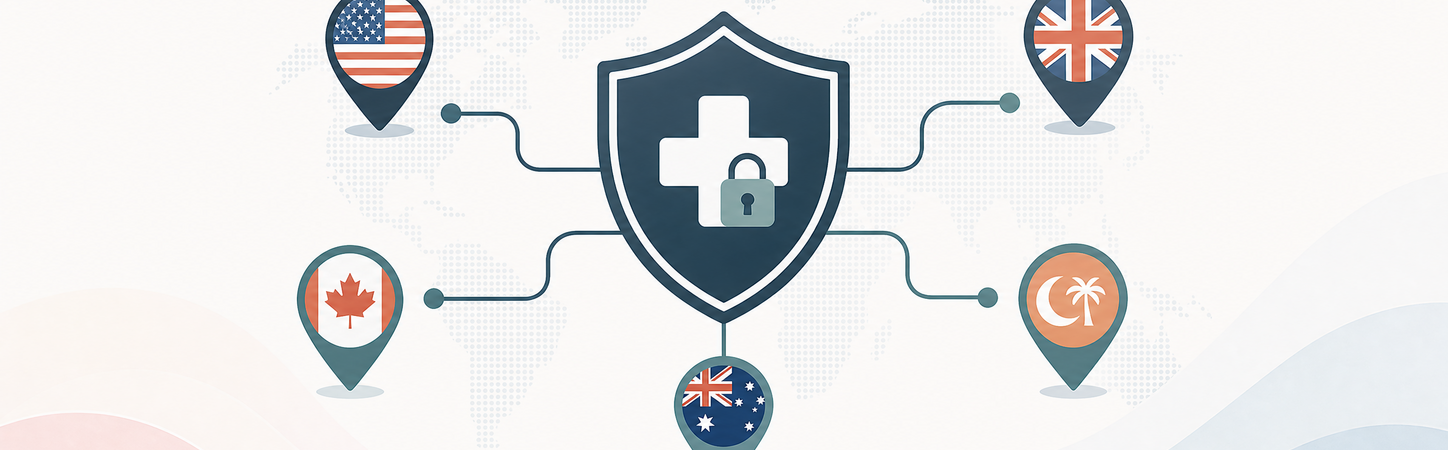
You have built a cardiac monitoring wearable or a remote diagnostics platform. It works. It is clinically validated. And now your first enterprise enquiry comes from a hospital group in Toronto, a private clinic network in Dubai, an NHS-adjacent health services provider in Manchester, and a telehealth startup in Sydney — all in the same quarter. Each one asks the same question: are you compliant with our local regulations?
HIPAA — the Health Insurance Portability and Accountability Act — is what most of the English-speaking world thinks of when they hear the words "healthcare data privacy". It is the US framework, and it is the framework most global health tech builders know because the US market is large and well-documented. But HIPAA is a US federal law. It applies to US covered entities and their business associates. It has no legal standing in Toronto, Manchester, Dubai, or Sydney.
At Avantari, where health monitoring devices are designed for clinical deployment in multiple geographies, understanding these differences is not a legal formality. It is a product architecture decision.
This guide explains what HIPAA actually requires, maps it against the equivalent frameworks in Canada, the United Kingdom, Australia, and across the major MENA jurisdictions — UAE, Saudi Arabia, and Qatar — and tells you what the differences mean for your product, your data infrastructure, and your compliance programme.
HIPAA is a US-only law. If you are shipping a health product outside the United States, "HIPAA compliant" is not sufficient for the markets in this article. Each jurisdiction covered here has its own mandatory framework — and in several cases, the requirements are stricter.
1. What HIPAA Actually Requires — The Baseline You Are Comparing Against
HIPAA was enacted in 1996 and significantly expanded by the HITECH Act of 2009. It applies to covered entities — healthcare providers, health plans, and healthcare clearinghouses — and to their business associates: any third party that creates, receives, maintains, or transmits protected health information (PHI) on behalf of a covered entity. HIPAA has five primary rules that shape healthcare data handling in the US.
The Privacy Rule
Sets national standards for how PHI may be used and disclosed. Covered entities may disclose PHI without patient authorisation for treatment, payment, and healthcare operations. Most other disclosures require written patient authorisation. Patients have the right to access their own records, request corrections, and receive an accounting of disclosures.
The Security Rule
Applies specifically to electronic PHI (ePHI). Requires covered entities and business associates to implement administrative, physical, and technical safeguards. Administrative safeguards include risk analysis, workforce training, and contingency planning. Physical safeguards cover facility access controls and workstation security. Technical safeguards require access controls, audit logs, integrity controls, and transmission security (encryption).
The Breach Notification Rule
Covered entities must notify affected individuals within 60 days of discovering a breach involving unsecured PHI. If a breach affects 500 or more individuals, the entity must also notify HHS and prominent media outlets in the state. Business associates must notify covered entities within 60 days of discovering a breach.
The HITECH Expansion
The Health Information Technology for Economic and Clinical Health Act of 2009 extended HIPAA directly to business associates, increased civil penalties (up to $1.9 million per violation category per year), and introduced tiered penalty tiers based on culpability. The 2025 HIPAA Security Rule update introduced mandatory multi-factor authentication (MFA) requirements and stricter rules governing the use of website tracking pixels.
HIPAA is not the world's strictest health data law. The UK GDPR, Australia's Privacy Act, and several MENA frameworks impose faster breach notification requirements, broader definitions of personal data, and in some cases explicit consent requirements that HIPAA does not mandate.
2. Side-by-Side Comparison: HIPAA vs Global Healthcare Privacy Frameworks
The table below summarises the key dimensions of each framework. A full discussion of each jurisdiction follows in subsequent sections.
| Criterion | HIPAA (USA) | Canada PIPEDA/PHIPA | UK GDPR/DSPT | Australia Privacy Act | MENA (UAE/KSA/Qatar) |
|---|---|---|---|---|---|
| Governing law | HIPAA 1996 + HITECH 2009 | Federal: PIPEDA 2000. Provincial: PHIPA (ON), FOIPPA (BC), HIA (AB) | UK GDPR (post-Brexit), Data Protection Act 2018, NHS DSPT | Privacy Act 1988, Australian Privacy Principles (APPs), My Health Records Act 2012 | UAE: Federal Law No. 45/2021 (PDPL). KSA: PDPL 2021 (amended 2024). Qatar: Law No. 13/2016 (PDPPL) |
| Who must comply | Covered entities + business associates — healthcare providers, plans, clearinghouses | PIPEDA: all private-sector orgs. PHIPA (ON): health information custodians only | Any org processing UK residents' health data — public NHS and private providers | APP entities: all health service providers regardless of turnover; other orgs if turnover >AU$3M | Any entity processing personal/health data of residents of those countries |
| Patient consent model | Treatment, payment, operations allowed without consent; explicit consent for most other uses | Meaningful consent required; exceptions for treatment and legal obligations | Explicit consent for special category (health) data; legitimate interests not a valid basis for health data | Consent or permitted health situation; direct use between treating professionals permitted | Explicit consent generally required; UAE/KSA do not recognise "legitimate interests" as a processing basis |
| Breach notification | Notify individuals within 60 days; HHS within 60 days; >500 persons notified to media | PIPEDA: notify OPCC and individuals "as soon as feasible". PHIPA: notify Commissioner | 72 hours to ICO; individuals "without undue delay" if high risk | NDB scheme: notify OAIC and individuals "as soon as practicable" | UAE: 72 hours. KSA: notify SDAIA promptly. Qatar: within 72 hours |
| Maximum penalty | $100–$1.9M per category per year; criminal penalties up to $250K and 10 years | PIPEDA: up to CA$100,000. QC Law 25: up to CA$25M or 4% global revenue | Up to £17.5M or 4% global annual turnover | Up to AU$50M (2023 amendments); AU$2.5M for serious repeat breaches | UAE: AED 20M (≈US$5.4M). KSA: SAR 5M (≈US$1.3M). Qatar: QAR 5M (≈US$1.4M) |
| Data localisation | No general requirement | No strict localisation; cross-border transfers permitted with equivalent protection | No strict localisation under UK GDPR; international transfers must meet adequacy/SCCs | No general localisation; some sector-specific requirements for My Health Records data | KSA: health data generally must remain in-Kingdom. UAE/Qatar moving in same direction |
| Enforcement body | HHS Office for Civil Rights (OCR) | Federal: OPC Canada. Provincial: IPC Ontario, OIPC BC/AB | UK Information Commissioner's Office (ICO) | Office of the Australian Information Commissioner (OAIC) | UAE: UAE Data Office. KSA: SDAIA. Qatar: National Cyber Governance and Assurance Affairs |
3. Canada: PIPEDA, PHIPA, and the Patchwork of Provincial Health Laws
Canada does not have a HIPAA equivalent at the federal level. What it has instead is a layered system of federal and provincial legislation that together covers most of the same ground — but with important structural differences that affect how you build for the Canadian market.
PIPEDA — The Federal Baseline
The Personal Information Protection and Electronic Documents Act (PIPEDA) is Canada's federal private-sector privacy law. It applies to all organisations engaged in commercial activity across provincial and international borders, and requires them to obtain meaningful consent before collecting, using, or disclosing personal information — including health information. PIPEDA is not health-specific: it covers all personal information in commercial contexts. Unlike HIPAA, PIPEDA does not specify technical security standards. Instead, it requires organisations to use security safeguards appropriate to the sensitivity of the information — a principle-based rather than rules-based approach.
PHIPA — Ontario's Health-Specific Law (and Why It Matters Most)
Ontario's Personal Health Information Protection Act (PHIPA) is the closest Canadian equivalent to HIPAA's health-specific scope. It applies to health information custodians — physicians, hospitals, pharmacists, laboratories, and other health service providers — and governs how they collect, use, disclose, and protect personal health information. Ontario has the largest population of any Canadian province and houses the country's largest health system, so PHIPA compliance is effectively mandatory for any health product sold into the Canadian market.
Key differences from HIPAA: PHIPA requires that patients be informed of their privacy rights and that health information custodians designate a contact person for privacy matters. Breach notification under PHIPA is required to both the custodian and to the Ontario Information and Privacy Commissioner. The IPC has authority to conduct audits and order compliance — more proactive oversight than the OCR's complaint-driven US model.
Other Provincial Laws — British Columbia, Alberta, and Quebec
British Columbia and Alberta have enacted their own substantially similar health privacy legislation — FOIPPA and Alberta's HIA respectively. Quebec has gone further: Bill 64 (Law 25), which came into full effect in 2023, introduced GDPR-style requirements including mandatory privacy impact assessments and penalties up to CA$25 million or 4% of global revenue — the stiffest penalties in Canadian privacy law.
What This Means for Builders
Appoint a Privacy Officer — both PIPEDA and PHIPA expect a designated privacy contact.
Implement a written privacy policy in plain language accessible to patients.
Conduct and document a Privacy Impact Assessment (PIA) before launch — mandatory under PHIPA for new systems.
Ensure business associate equivalents (called "agents" under PHIPA) have written agreements governing health information handling.
Plan for breach notification within a "reasonable time" under PIPEDA — and more specifically to the IPC under PHIPA.
Quebec Law 25: If your product serves Quebec users, Law 25 brings GDPR-level requirements into the Canadian context, including mandatory privacy impact assessments and data minimisation requirements. The CA$25M maximum penalty makes it the most consequential Canadian jurisdiction for non-compliance.
4. United Kingdom: UK GDPR, the Data Protection Act 2018, and the NHS DSPT
The United Kingdom's post-Brexit data protection framework is built on the UK GDPR — the retained version of the EU General Data Protection Regulation, modified by the Data Protection Act 2018 (DPA 2018). For healthcare data specifically, the UK also operates the NHS Data Security and Protection Toolkit (DSPT) as a mandatory compliance framework for any organisation accessing NHS systems or processing NHS-held data.
UK GDPR and Health Data
Under UK GDPR, health data is classified as a special category of personal data requiring enhanced protection. The lawful basis for processing health data is more restricted than for ordinary personal data: organisations typically rely on explicit consent, substantial public interest (under Schedule 1 of the DPA 2018), or vital interests. Unlike HIPAA, which permits broad use of PHI for treatment, payment, and operations without patient consent, UK GDPR requires a specific lawful basis for every data processing activity involving health data. Consent must be freely given, specific, informed, and unambiguous — it cannot be bundled with other terms and conditions. Patients can withdraw consent at any time.
The NHS Data Security and Protection Toolkit
The DSPT is the NHS's own data security compliance framework. It is mandatory for NHS Trusts, Integrated Care Boards, GP practices, pharmacies, and all independent providers working under NHS contracts or accessing NHS systems. In 2025-26, the DSPT underwent its most significant update (Version 8) since launch. The June 2026 deadline for Version 8 compliance introduced new requirements around multi-factor authentication, cyber incident response, and supply chain security — requirements that now extend to IT suppliers and software vendors with NHS access.
Breach Notification Under UK GDPR vs HIPAA
UK GDPR requires reporting a personal data breach to the ICO within 72 hours of becoming aware of it — if it is likely to result in a risk to individuals' rights and freedoms. If the breach is likely to result in high risk, affected individuals must also be notified without undue delay. Compare this with HIPAA's 60-day window: the UK timeline is significantly more demanding.
What This Means for Builders
Register with the ICO as a data controller if your organisation processes UK residents' health data.
Map every data processing activity involving health data and identify the lawful basis — explicit consent or a DPA 2018 Schedule 1 condition.
Complete a Data Protection Impact Assessment (DPIA) before deploying any new health data processing system.
If selling to the NHS or NHS-adjacent organisations: plan for DSPT compliance from the beginning. It is a procurement gate, not an afterthought.
Appoint a Data Protection Officer (DPO) — mandatory for organisations processing health data at scale.
Build 72-hour breach notification capability into your incident response plan from day one.
5. Australia: The Privacy Act 1988, Australian Privacy Principles, and My Health Records
Australia's health data privacy framework is anchored in the Privacy Act 1988 — a broad economy-wide law that predates HIPAA by eight years. The Privacy Act is enforced by the Office of the Australian Information Commissioner (OAIC) and applies to Australian Government agencies and private-sector organisations. Health service providers — including doctors, hospitals, pharmacists, and allied health practitioners — must comply with the Australian Privacy Principles (APPs) regardless of their size.
Key APPs for Health Product Builders
APP 6 (Use or disclosure): Health information may generally only be used or disclosed for the primary purpose for which it was collected, or for a directly related secondary purpose with reasonable patient expectations. This is narrower than HIPAA's broad treatment/operations exception.
APP 8 (Cross-border disclosure): Before disclosing personal information to an overseas recipient, an APP entity must take reasonable steps to ensure the overseas recipient does not breach the APPs. Cloud hosting arrangements in non-Australian jurisdictions need careful structuring.
APP 11 (Security of personal information): Organisations must take reasonable steps to protect personal information from misuse, interference, loss, unauthorised access, modification, or disclosure.
The My Health Records Act 2012
Australia operates a national, government-run electronic health record system. The My Health Records Act 2012 governs this system separately from the general Privacy Act framework. The Australian Digital Health Agency (ADHA) administers the system and sets technical security standards for connected systems — including requirements around identity verification, audit logging, and access controls analogous to HIPAA's technical safeguards.
The Notifiable Data Breaches Scheme
Australia's NDB scheme requires covered entities to notify the OAIC and affected individuals of eligible data breaches as soon as practicable after discovery. The Privacy Act was significantly amended in 2023, with penalties for serious or repeated breaches increased to the greater of AU$50 million, three times the value of the benefit obtained, or 30% of the entity's adjusted turnover — at parity with GDPR-level fines for major organisations.
What This Means for Builders
Understand whether your product is a regulated medical device under Australia's Therapeutic Goods Administration (TGA) — a separate regulatory layer from privacy law.
Privacy Act coverage applies even if your organisation is foreign-based, if you collect health information from Australian individuals.
For My Health Records integration: register with ADHA, complete a conformance assessment, and implement the required technical standards.
Structure cloud hosting arrangements to address APP 8 cross-border disclosure obligations — use model clauses or ensure overseas processors offer equivalent protections.
TGA Compliance: If your health tech product makes a diagnostic or therapeutic claim, it may be classified as a medical device in Australia and subject to TGA registration — in addition to Privacy Act compliance. These are two separate regulatory tracks that must both be managed.
6. MENA: UAE PDPL, Saudi Arabia's PDPL, and Qatar's PDPPL
The Middle East and North Africa region has undergone a rapid regulatory transformation in health data privacy since 2020. Driven by the UAE's Digital Government Strategy, Saudi Vision 2030, and Qatar's National Vision 2030, the three largest GCC healthcare economies have enacted or significantly updated comprehensive data protection laws. These are no longer emerging frameworks: they are enforceable law with meaningful penalties.
United Arab Emirates — Federal Law No. 45 of 2021 (PDPL)
The UAE's Personal Data Protection Law applies to all entities processing personal data in the UAE or processing data of UAE residents from abroad. Health data is classified as "sensitive personal data" and subject to enhanced requirements. The UAE PDPL requires explicit consent for processing sensitive personal data unless processing is necessary for vital interests, legal obligations, or legitimate health purposes. Unlike UK GDPR, the UAE law does not recognise "legitimate interests" as a processing basis for sensitive data. Maximum penalties reach AED 20 million (approximately US$5.4 million).
Additionally, the Dubai International Financial Centre (DIFC) and Abu Dhabi Global Market (ADGM) operate their own separate data protection frameworks — both closely modelled on UK GDPR. Companies operating within these free zones must comply with the zone-specific framework, not the federal PDPL.
Kingdom of Saudi Arabia — Personal Data Protection Law (PDPL)
Saudi Arabia enacted its PDPL in 2021, with full enforcement beginning in 2023. Amended most recently in April 2025 and overseen by the Saudi Data and AI Authority (SDAIA), it applies to the processing of personal data of Saudi residents regardless of where the processing entity is located. The KSA National Cybersecurity Authority (NCA) has published Health Sector Cybersecurity Controls (HSCC) — mandatory technical requirements covering encryption, access management, audit logging, and incident response.
Saudi Arabia maintains a general presumption in favour of health data localisation. Sensitive personal data should generally be processed and stored within the Kingdom. Cross-border transfers require SDAIA approval unless an exemption applies — this has direct implications for cloud infrastructure decisions.
Qatar — Personal Data Privacy Protection Law No. 13 of 2016
Qatar's PDPPL is the oldest comprehensive data protection law in the GCC. Processing sensitive personal data — including health information — requires explicit written consent or approval of the relevant authority. Data must be held securely, limited to its original purpose, and not transferred abroad without the controller ensuring equivalent protection exists.
What This Means for Health Tech Builders in MENA
Understand which jurisdiction(s) apply to your product — the federal PDPL in the UAE, the DIFC framework, the ADGM framework, or all of the above if you operate across UAE entities.
Design for explicit consent collection from day one — MENA frameworks do not allow the implicit treatment-and-operations exceptions that HIPAA uses.
Evaluate cloud infrastructure early: KSA requires health data localisation in-country. If you are deploying in Saudi Arabia, your cloud provider must have a KSA region, or you need a local hosting arrangement.
Review the Saudi NCA Health Sector Cybersecurity Controls (HSCC) if you are entering the KSA healthcare market — these are technical standards with specific controls, not principle-based guidance.
In Qatar, ensure any third-party data processing agreements explicitly address PDPPL requirements and that overseas transfers have documented equivalent protection.
MENA health data frameworks are evolving faster than almost any other region. Saudi Arabia amended its PDPL twice in three years. UAE guidance on data localisation is expected in 2026. If you are planning a 12-month product roadmap for MENA, build in a compliance review at the six-month mark.
7. What Cross-Border Data Transfers Mean for Your Health Product
A health app or connected device that stores data in the cloud almost always involves cross-border data transfers — even if the device is used in one country, the cloud infrastructure may span multiple regions. Every framework in this article has rules governing this, and the rules are different enough that a single global data architecture needs to be carefully reviewed against each jurisdiction's requirements.
The Key Transfer Mechanisms
Most frameworks offer three mechanisms for lawful cross-border transfers: adequacy decisions (the destination country is deemed to offer equivalent protection), contractual safeguards (standard contractual clauses), and explicit consent. HIPAA has the least restrictive approach — international transfers are permitted as long as the overseas business associate signs a Business Associate Agreement (BAA) meeting HIPAA standards. UK GDPR, Australia's APP 8, and the MENA frameworks are more demanding.
Data Localisation Pressure
Saudi Arabia is the most explicit about requiring health data to remain in-country, but the UAE and Qatar are moving in the same direction. Australia's My Health Records system stores data exclusively in Australian data centres. Canada's provincial health laws have similar expectations for provincially funded health data. For a product sold into multiple markets, the practical implication is that single-instance global databases will not satisfy all requirements — you may need regional data residency for each jurisdiction.
The US-EU and US-UK Data Privacy Frameworks
Companies that need to transfer health data between the US and EU (or the US and UK) should understand the EU-US Data Privacy Framework (DPF) — finalised in 2023 — and the UK-US extension. These provide a legal mechanism for transatlantic transfers without requiring standard contractual clauses on a case-by-case basis. However, health data remains subject to enhanced requirements even within these frameworks, and the DPF does not remove HIPAA obligations for covered entities.
8. Practical Compliance Checklist for Medtech and Digital Health Builders
At Product Design Stage (Before First Line of Code)
Define your target markets and map the applicable frameworks to each — do not assume HIPAA compliance transfers.
Identify what constitutes "health data" in each jurisdiction — definitions vary and affect whether your data is subject to enhanced rules.
Design your data architecture for regional data residency from the start — retrofitting localisation is expensive.
Determine the lawful basis for processing in each market — consent, legitimate health purpose, or statutory authority.
Plan your consent flows for the strictest market you will enter (typically UK GDPR or MENA) and apply that standard globally.
At Development Stage
Implement encryption at rest and in transit as a baseline — required by HIPAA, UK GDPR, APPs, and MENA frameworks.
Build access control with role-based permissions and audit logging — mandatory across all frameworks covered here.
Implement MFA — now mandatory under the 2025 HIPAA Security Rule update and best practice under all other frameworks.
Document your security architecture for auditors — frameworks like the NHS DSPT and KSA HSCC require evidence-based compliance, not self-attestation.
Before Launch
Conduct a Data Protection Impact Assessment (DPIA/PIA) — mandatory under UK GDPR, required under PHIPA (Canada), strongly recommended under APPs, and expected by MENA regulators.
Prepare privacy notices and consent forms for each jurisdiction — these are not interchangeable documents.
Establish a breach notification process with documented timelines: 60 days (HIPAA), 72 hours (UK GDPR, UAE), as soon as practicable (Australia), reasonable time (Canada/PIPEDA).
If entering the NHS supply chain: complete DSPT registration and achieve minimum standards before procurement conversations.
Post-Launch and Ongoing
Conduct annual privacy risk assessments — required or strongly recommended by all frameworks.
Monitor regulatory updates — particularly in MENA, where PDPL amendments and new guidance are published frequently.
Maintain records of processing activities — mandatory under UK GDPR, best practice under all other frameworks.
Train staff on data handling obligations — required by HIPAA, UK GDPR, and Canada's PHIPA.
Frequently Asked Questions About HIPAA and Global Healthcare Laws
Does HIPAA apply outside the United States?
No. HIPAA is a US federal law and applies only to US covered entities and their business associates. However, if a foreign company provides services to a US covered entity and handles PHI in the process — for example, a cloud provider hosting ePHI for a US hospital — that foreign company becomes a business associate and must sign a BAA and comply with HIPAA's requirements for the data it handles.
What is Canada's equivalent of HIPAA?
Canada does not have a single national health data law equivalent to HIPAA. At the federal level, PIPEDA covers personal information in commercial contexts. At the provincial level, Ontario's PHIPA is the most commonly cited health-specific equivalent. Alberta's HIA and British Columbia's FOIPPA serve similar roles in their provinces. Quebec's Law 25 has now introduced the strictest penalty regime in the country.
Is GDPR stricter than HIPAA for healthcare data?
In several important ways, yes. UK GDPR requires explicit consent for most health data processing where HIPAA allows treatment-and-operations exceptions. GDPR mandates breach reporting to authorities within 72 hours versus HIPAA's 60 days. GDPR imposes data minimisation, purpose limitation, and data subject rights (including deletion) that HIPAA does not. However, HIPAA is more prescriptive about technical security safeguards — the Security Rule's specific technical requirements go beyond GDPR's more principle-based approach to security.
Do MENA health data laws require data to stay in the country?
This varies. Saudi Arabia has the most explicit localisation requirements: sensitive personal data, including health data, should generally be processed within the Kingdom. UAE guidance on this topic is evolving, but the general regulatory direction is towards domestic storage for sensitive data. Qatar's PDPPL imposes restrictions on overseas transfers. In practice, companies entering these markets should assume that health data localisation is either a current requirement or an imminent one.
What happens if you breach health data laws across multiple countries simultaneously?
Each jurisdiction's enforcement authority investigates independently. A single data incident involving health records from UK, Australian, and Canadian patients could result in parallel investigations by the ICO, OAIC, and OPC Canada respectively, with penalties assessed separately by each authority. The total financial exposure across multiple jurisdictions can substantially exceed the individual cap in any single country.
Do I need separate privacy policies for each market?
Not necessarily separate documents, but separate sections addressing each jurisdiction's requirements. UK GDPR mandates specific disclosures (lawful basis, retention periods, DPO contact, right to lodge a complaint with the ICO) that are not required by HIPAA. Australia requires disclosure of APP 1 compliance. Canadian PHIPA requires disclosure of the contact person for privacy enquiries. A well-structured privacy notice can address all of these in a single document with jurisdiction-specific sections, but the content is genuinely different for each market.
Conclusion
Healthcare data privacy is not a single global standard. HIPAA is the baseline most health tech teams know, but it is a US-only law — and every market covered in this guide has its own enforceable framework with meaningfully different requirements around consent, breach notification, data localisation, and penalties.
At Avantari, we build medical wearables and connected health devices designed for clinical deployment across multiple geographies. If you are building a connected health product and want to discuss how to structure your technical architecture for multi-market compliance, visit avantari.org or start a conversation with our team. We respond within one business day.
KEEP READING

PROCESS
How to Choose a Medical Device Development Partner: 9 Questions to Ask Before You Sign
Nine questions to ask a medical device development partner before you sign: experience, quality system, firmware, cybersecurity, manufacturing, IP, cost.

PROCESS
IoT Testing Guide
A practical IoT testing guide covering firmware testing, BLE protocol validation, OTA update testing, security testing, and performance testing for connected devices. Written by hardware engineers with 12+ years of IoT product experience.

PROCESS
Product Development: The Complete Guide for Hardware Founders & Product Teams
From first idea to factory floor — a practical, end-to-end guide built for founders, PMs, and entrepreneurs navigating the complexity of physical product development.
NEWSLETTER
We write when we’ve actually built something.