PROCESS · 13th October 2026 · 14 min read
From Working Prototype to FDA Submission: The 7 Workstreams Between You and a Filing
A practical breakdown of the seven overlapping workstreams between a working prototype and an FDA submission — intended use, design freeze, verification, human factors, validation, manufacturing transfer and the quality file — for founders planning a 510(k) filing.
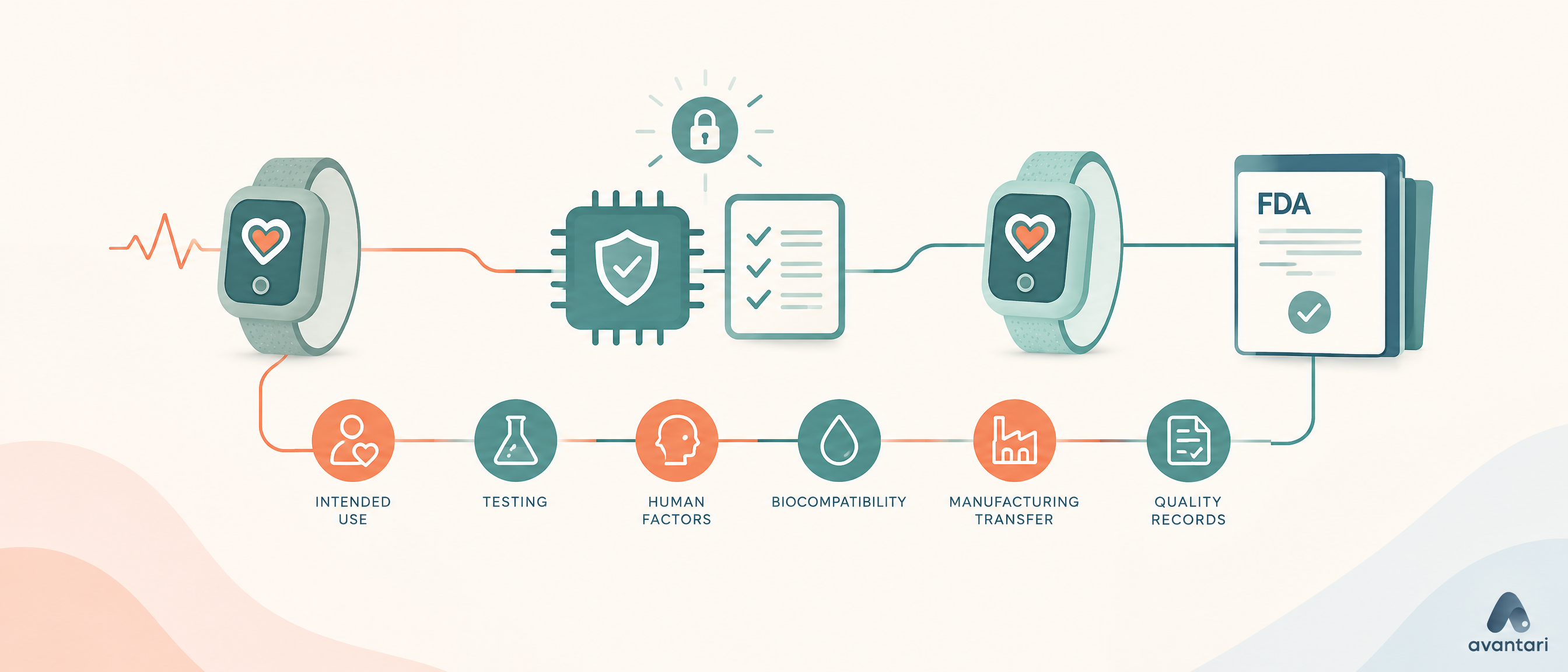
The prototype works. It reads the signal, the app shows the number, and the demo lands well with investors. Then someone asks when you will file, and the honest answer is that nobody in the room knows, because the work between here and there is not one task. It is seven, they overlap, and the order matters more than the effort.
This is for founders and product leads with a working connected wearable or monitor who are planning a US submission in the next year or so. It assumes you have chosen a regulatory path, or are close to it. If you are still choosing a development partner, start with our earlier guide on the nine questions to ask, then come back to this.
The short version
A demonstration prototype proves the idea is possible. A submission proves the finished device is safe and effective, and that you can build it the same way every time. Those are different claims, and the second one needs evidence created under design controls, on the final design, using devices built the way production will build them.
That last sentence is where most schedules go wrong. Testing done on an earlier board, an earlier material or an earlier firmware build usually has to be repeated.
Workstream 1: Pin down the claim, the user and the path
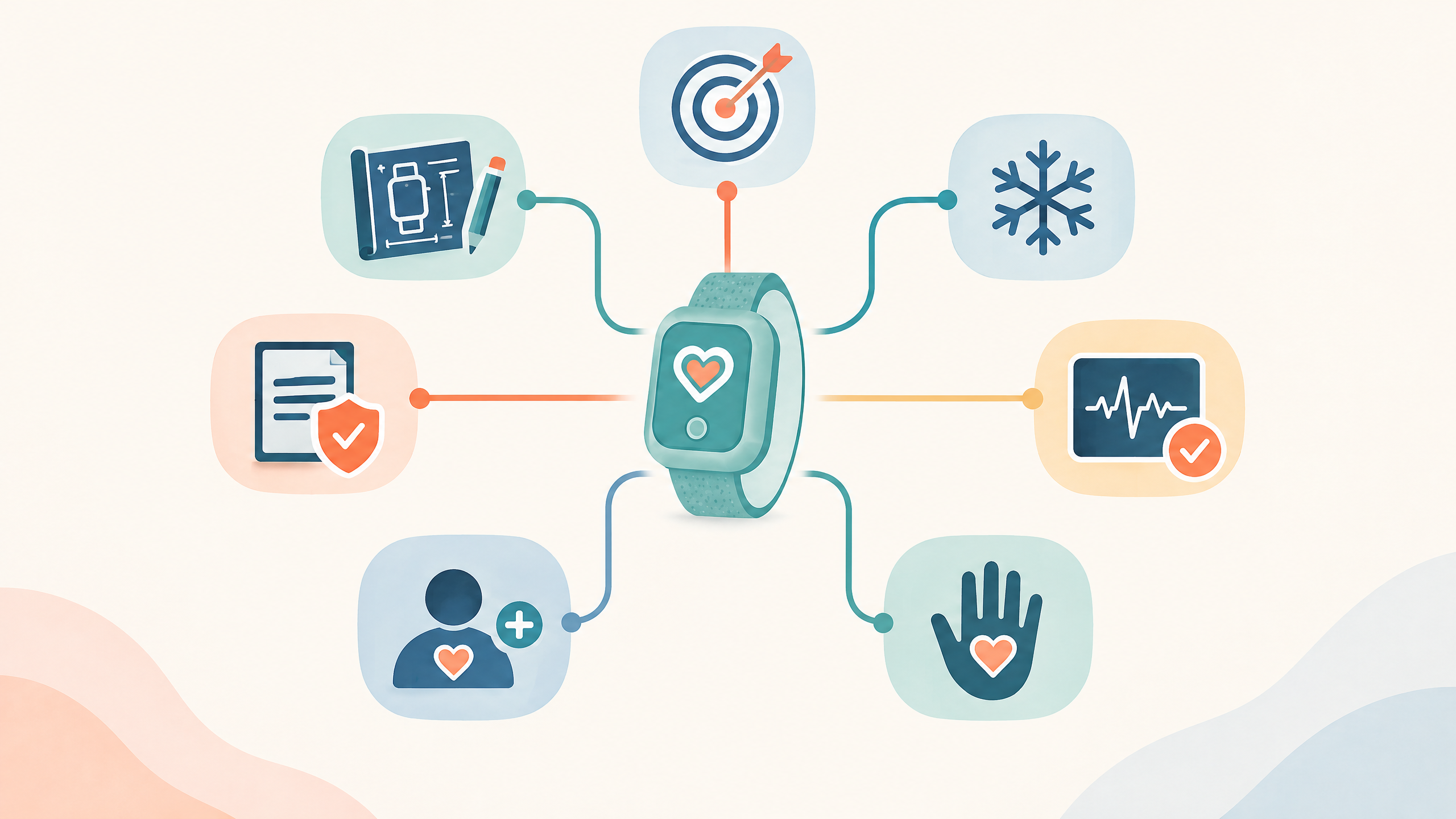
Everything downstream is shaped by one sentence: what the device does, for whom, in what setting. It decides your classification, whether a predicate exists, what testing applies and what your labelling may say. Write it early, and treat changes to it as a serious event rather than a marketing tweak.
For a 510(k), FDA looks at whether your device has the same intended use as a legally marketed predicate and whether any differences in technology raise new questions of safety or effectiveness. Performance data supporting that comparison can include bench engineering tests, electromagnetic compatibility, software validation, biocompatibility and, where bench data cannot answer the question, clinical data.
Use the Pre-Submission programme before you commit money to a test plan. A Pre-Sub is free, open to any company considering a submission, and lets you put written questions to the reviewers about your pathway, predicate choice, test protocols or study design. FDA aims to send written feedback by day 70. Build that into the plan rather than treating it as a delay.
Workstream 2: Turn the prototype into a specified design
A prototype embodies decisions. A design specifies them. This workstream converts intent into design inputs: sensing performance, accuracy limits, wear time, battery life, ingress protection, wireless behaviour, alarms, error states, cleaning and the conditions all of it must survive.
Two traps show up repeatedly in wearables. The first is materials. Biocompatibility testing under the ISO 10993 family depends on what touches the body, for how long. Finalising materials before mapping which tests apply is how teams end up changing an adhesive or a housing late and repeating hardware validation. The second is cybersecurity. If the device connects, even through a phone, patchability has to be designed into the hardware.
Workstream 3: Design freeze, then verification
Verification answers a narrow question: does the built device meet its written specifications? Electrical safety, EMC, durability, ingress, battery, signal accuracy against a reference, software against requirements. It only counts against the design you are actually going to sell, which is why the freeze comes first and why late changes are so expensive.
The practical rule: a change after freeze means asking which tests it invalidates. Sometimes none. Sometimes a full cycle. Deciding this deliberately, in writing, is the difference between a slip of two weeks and one of two quarters.
Workstream 4: Human factors, on the real device
This is the workstream most often discovered late, and in 2026 it carries new documentation expectations. FDA finalised its guidance on the content of human factors information in marketing submissions in May 2026, with an implementation date of 1 August 2026. It uses a risk-based framework that sorts submissions into categories according to whether critical tasks are involved or affected. It complements, rather than replaces, the older guidance on how to run the usability process.
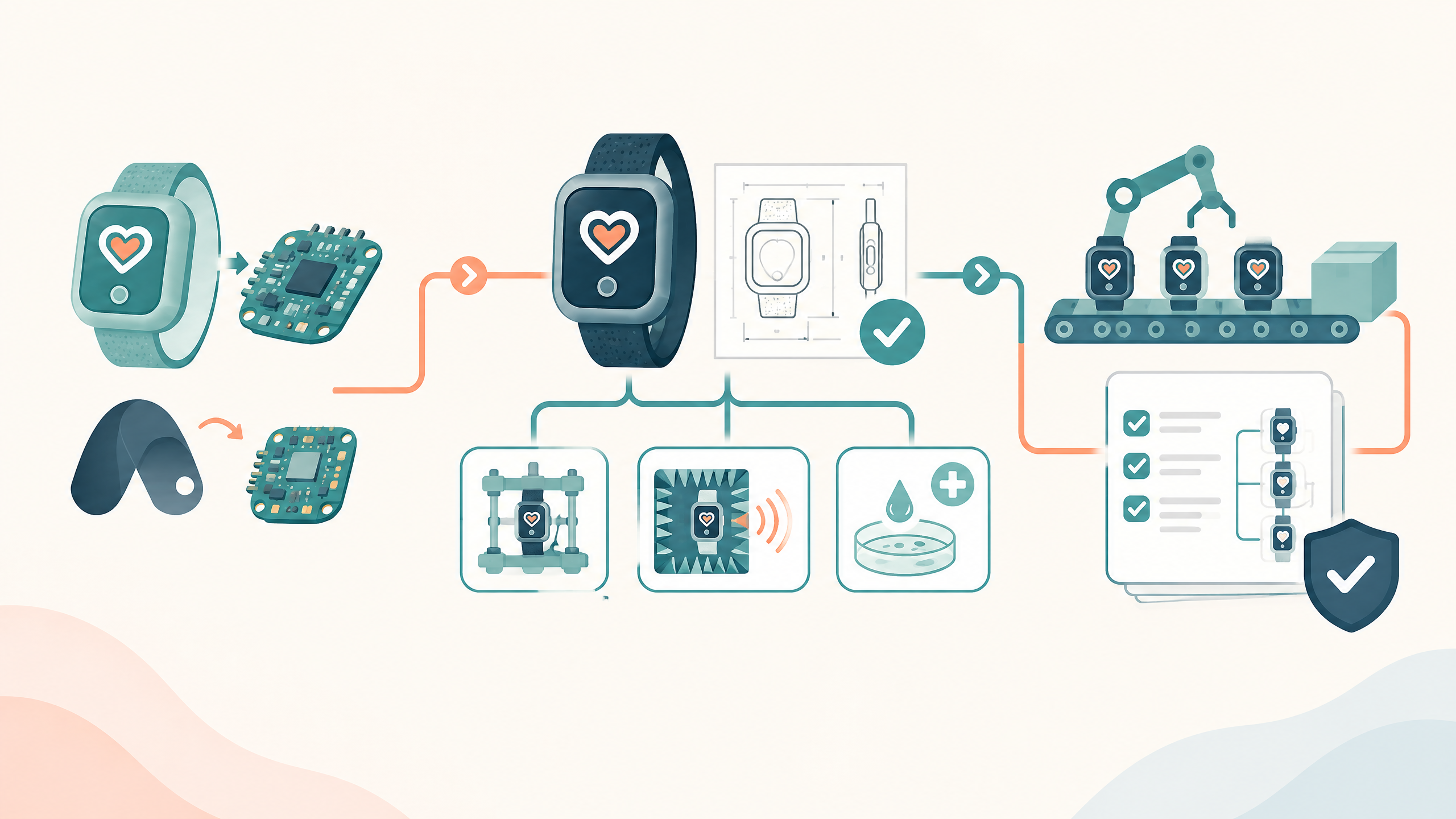
In practice: identify the tasks where an error could cause serious harm, run informal testing while the design can still change, then run a final validation study with representative users performing those tasks on the finished device and labelling. Doing the formal study on a prototype does not count. Neither does discovering, during it, that the wearing instructions are confusing, because the fix is a design or labelling change that reopens work you thought was closed.
Workstream 5: Validation and, where needed, clinical evidence
Validation asks the wider question: does the device meet the needs of real users in the real setting? For a wearable, that usually means performance on bodies that move, sweat, have different skin tones and wear the device at home rather than in a lab.
Whether you need clinical data depends on whether bench testing can support your claim. Decide it with FDA in the Pre-Sub rather than guessing, because a clinical study reshapes the whole plan: protocol, sites, ethics approval, possibly an investigational device exemption, and months of recruitment.
Workstream 6: Design transfer and manufacturing
Submission-grade evidence should come from devices built by the process that will make them at volume, with the same components, the same assembly and the same tests. This is design transfer: the point where drawings, tolerances, work instructions, test fixtures and acceptance criteria hand over to a production line.
Start it before verification finishes, not after. Teams that treat transfer as the last step discover component availability problems, assembly steps that cannot be done repeatably, or tests that pass on the bench and fail on the line, at the worst possible moment.
Workstream 7: The quality system and the submission file
From 2 February 2026 the FDA's Quality Management System Regulation incorporates ISO 13485:2016 by reference, so the design records you keep for the United States and for other markets are now largely the same set. Risk management under ISO 14971 runs throughout, and software work follows IEC 62304 with a safety class assigned early.
One naming change worth knowing: what the old US rules called the Design History File now sits within the design and development records in ISO 13485 terms. The substance is the same. Requirements trace to design outputs, outputs trace to verification results, risks trace to controls and to evidence the controls work.
On the mechanics, FDA now strongly encourages eSTAR for most 510(k)s. It is a structured template with built-in completeness checks, which means missing sections are caught by the form rather than discovered later. Useful if your file is genuinely complete; unforgiving if it is not.
A realistic order of play
Write the intended use, users and setting. Confirm the pathway and shortlist a predicate.
Map applicable tests, including biocompatibility by contact type and duration.
File a Pre-Sub with your pathway and test plan. Expect written feedback around day 70.
Complete the design, using the Pre-Sub feedback. Run informal usability testing while change is still cheap.
Freeze the design. Build units on the intended process.
Run verification and biocompatibility. Start design transfer in parallel.
Run human factors validation and any clinical work on the frozen design.
Assemble the file in eSTAR. Check labelling claims match your evidence, exactly.
Review time is its own stage. The statutory clock for a traditional 510(k) is 90 days, though in practice teams often see several months once requests for additional information are counted. Plan runway for that, not just for the filing date.
Five ways the schedule slips
Changing the intended use late. It can invalidate predicate choice, test plan and labelling at once.
Testing on a moving design. Any result generated before freeze may have to be repeated.
Materials chosen before biocompatibility is mapped. A late adhesive or housing change is rarely just a late change.
Human factors treated as a documentation task. The final study can uncover design and labelling problems.
Manufacturing left until the end. A design that cannot be built repeatably is not finished, whatever the test reports say.
A design that cannot be built repeatably is not finished, whatever the test reports say.
Where an engineering partner actually helps
Most of this is engineering work with regulatory consequences, not paperwork. Getting the architecture, materials, firmware and test design right early is what keeps the seven workstreams from colliding. That is the work we do at Avantari: PCB and embedded hardware, firmware, embedded AI and device interfaces, through prototyping to manufacturing handoff, on products including the Ein cardiac wearable and the Dhyana 2 smart ring.
We are not a regulatory consultancy, and you will still want regulatory and clinical specialists alongside us. You can read more about how our engineering work applies to regulated products on our medical device development page.
Frequently Asked Questions
How long does it take to go from prototype to FDA submission?
It depends on how much of the design is genuinely frozen, whether you need clinical data, and how quickly test slots and Pre-Sub feedback arrive. Rather than a single figure, build your plan around the fixed waits you can name: about 70 days for Pre-Sub written feedback, laboratory lead times for biocompatibility and EMC, recruitment time for any study, and a 90-day statutory review clock afterwards.
Do I need a Pre-Submission meeting with FDA?
It is voluntary, free, and generally worth it before you spend money on a test plan. You can ask about your pathway, predicate choice, testing strategy or study design and get written answers you can point to later.
What is a design freeze, and when should it happen?
It is the point where the design stops changing so that verification, human factors validation and manufacturing can all work from the same version. It should happen after informal usability testing and after your Pre-Sub feedback, and before you start formal verification. Changes afterwards are possible, but each one needs a decision about which evidence it invalidates.
Can I use my prototype units for verification testing?
Generally no. Submission evidence should come from units built to the final design using the intended manufacturing process. Prototype units are for the informal testing that comes before freeze.
What changed in FDA requirements during 2026?
Two things matter for this stage. The Quality Management System Regulation took effect on 2 February 2026, aligning FDA quality requirements with ISO 13485:2016. And new guidance on human factors content in submissions took effect on 1 August 2026, with a risk-based framework for what to include.
Does my development partner need to be ISO 13485 certified?
Not necessarily. As the legal manufacturer you can bring a partner into your own quality system as a controlled supplier. What matters is that design controls are followed and the records end up with you, complete.
Tell us where the design is still moving
If you have a working prototype and a filing in view, the useful conversation is about which parts of the design are not yet settled and what that does to your test plan. Send us what you have and we will tell you what we would lock down first. Talk to Avantari.
KEEP READING

PROCESS
How to Choose a Medical Device Development Partner: 9 Questions to Ask Before You Sign
Nine questions to ask a medical device development partner before you sign: experience, quality system, firmware, cybersecurity, manufacturing, IP, cost.

PROCESS
How HIPAA Relates to Healthcare Laws and Regulations Across Canada, the UK, Australia, and MENA
A practical compliance guide for medical device builders, health app founders, and digital health teams expanding into global markets

PROCESS
IoT Testing Guide
A practical IoT testing guide covering firmware testing, BLE protocol validation, OTA update testing, security testing, and performance testing for connected devices. Written by hardware engineers with 12+ years of IoT product experience.
NEWSLETTER
We write when we’ve actually built something.