AI · 21st September 2026 · 13 min read
Putting an AI Avatar in Your Museum, Airport or Hospital: 8 Decisions to Make Before You Commission One
Eight decisions to make before commissioning a live AI avatar for a museum, airport or hospital: hardware, latency, content control, language and accessibility, AI disclosure, and pilot design.
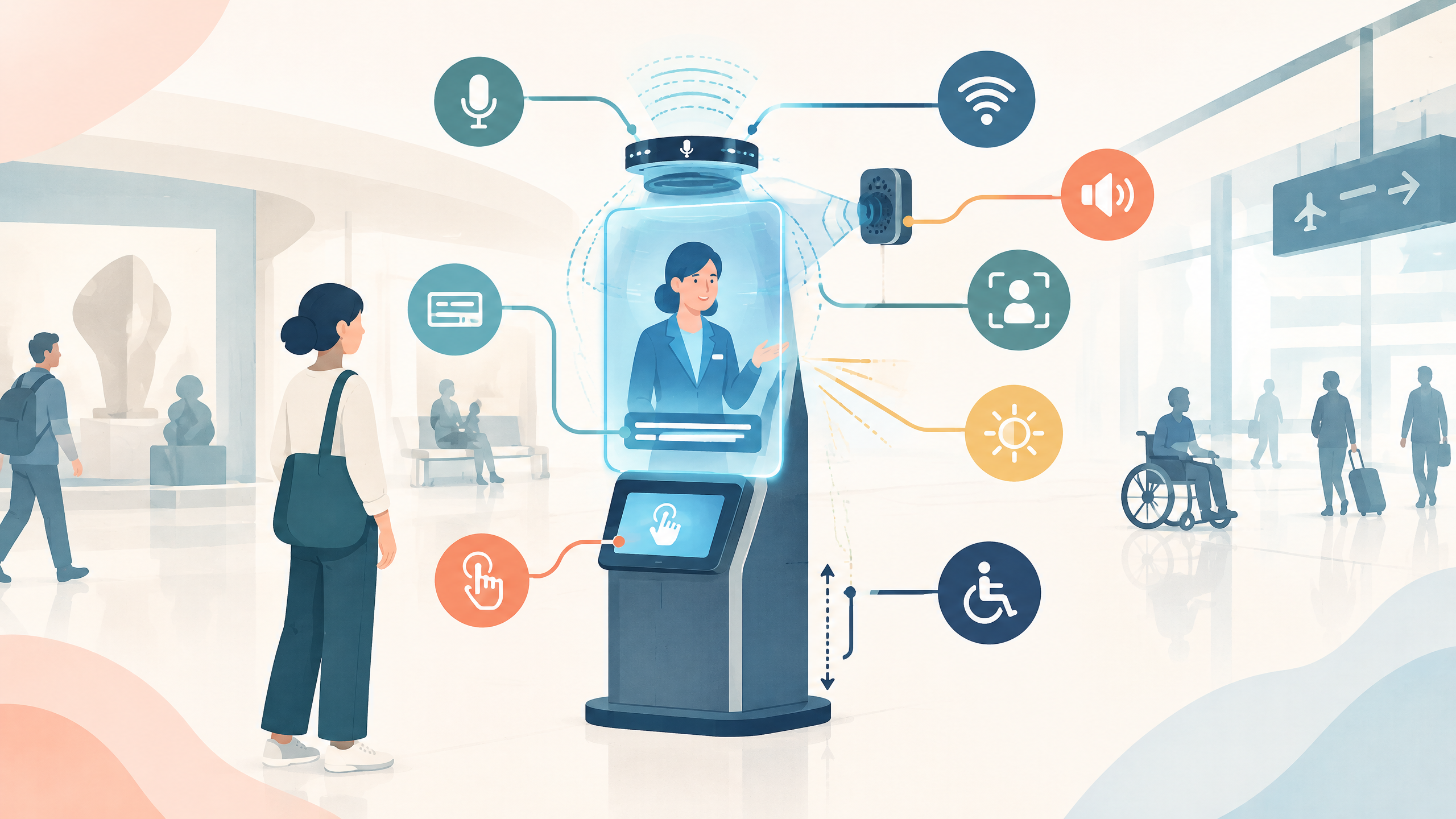
A talking avatar always looks wonderful in the vendor's demo room. The room is quiet, the questions are friendly and the Wi-Fi is perfect. Your concourse at five o'clock on a Friday is none of those things. Neither is a museum foyer with a school group in it, or an outpatient reception on a Monday morning.
This guide is for the person who has to make one of these work in a real building: the head of visitor or customer experience, the innovation lead, the digital director. It walks through eight decisions that determine whether your avatar becomes a useful member of the front-of-house team or an expensive screen people walk past.
What a live AI avatar is, and what it is not
A live avatar is a real-time digital person on a kiosk, a large display or a holographic unit. It listens to a spoken question and answers in a generated voice with matching facial movement, drawing on content you have approved or systems you have connected, such as flight information, an events calendar or a collections database.
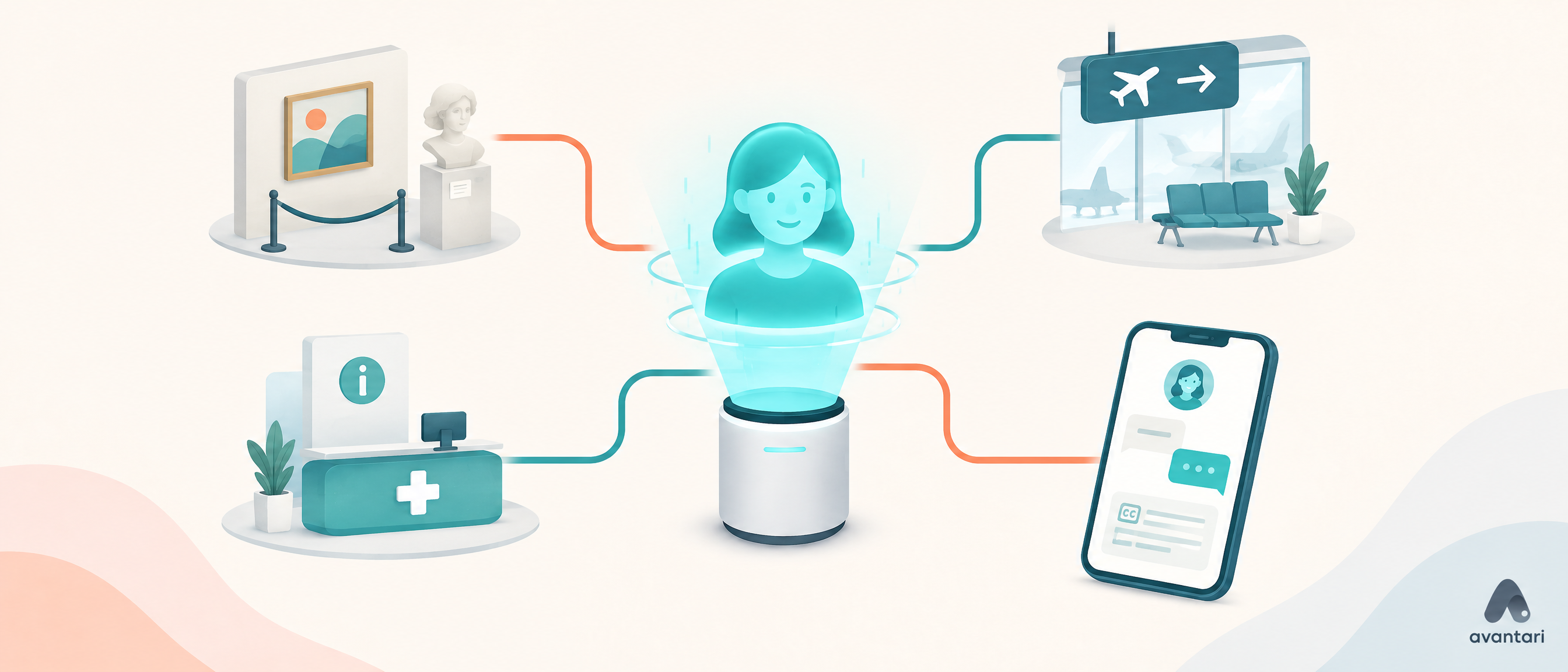
It is not a looping video of a presenter, and it is not a text chatbot with a face placed on top. The difference shows within seconds of use. A real one copes with interruptions, follow-up questions, a second language and someone asking something nobody planned for.
The eight decisions
1. Decide the job before you look at faces
Most public deployments do one of three jobs. A host welcomes people and helps them find their way. A service desk answers repeat questions, handles check-in or manages a queue. An interpreter lives at one exhibit or product and knows that subject deeply. Museums often describe the first as a digital docent and the third as an embedded interpreter.
Pick one for your pilot. Then do something unglamorous: ask your front-line staff to write down the fifty questions they hear most. That list is your specification. It tells you what content is needed, which systems must be connected and how you will know whether the avatar is any good.
2. Design for the room, because the room is the hardest part
Speech recognition that is flawless in an office falls apart next to a baggage carousel. The fixes are physical. A microphone array that focuses on the person standing in front. Directional speakers so the reply is heard by that person and not the whole hall. Presence detection so the avatar greets someone who approaches, instead of waiting for a wake word nobody knows.
Then the basics of any installed hardware: glare on the screen at different times of day, sightlines from the entrance, a height that works for a wheelchair user and a ten-year-old, ventilation, power, a network connection you control. A holographic unit draws a crowd from across the room. A flat display is easier to caption and cheaper to maintain. Which matters more depends on the job you chose in step one.
This is why we would encourage you to ask every vendor who designs the hardware. If the answer is "we ship a standard kiosk", ask to test that kiosk in your space, at your noisiest hour, before you sign.
3. Set a speed budget
In everyday conversation, people leave a gap of roughly a fifth of a second between turns. No AI pipeline matches that today. Speech recognition, the language model, voice generation and facial animation each take time, and the delays add up. After about two seconds of silence, people assume the thing is broken and walk off.
Treat response time as a budget shared between stages, agree it in writing, and monitor it once the system is live.
So treat response time as a budget shared between stages, agree it in writing, and monitor it once the system is live. Researchers who build museum guides make the same point: latency targets are budgets to watch, not guarantees. Good systems also manage the wait. They show that they are listening, acknowledge the question quickly and begin speaking while the rest of the answer is still being prepared.
Speed is also where the cloud, hybrid or on-site decision gets made. Running more of the pipeline on a computer inside the kiosk cuts delay and keeps working when the network drops. It costs more upfront. Your data governance rules may decide the question for you.
4. Decide what it is allowed to know
A public avatar should answer from material you have approved, and nothing else. That means a content set someone owns, a named person who signs off changes, and a simple route for updates when the gate, the opening hours or the exhibition changes.
Just as important is what happens at the edge of its knowledge. "I don't know that one, but the information desk to your left can help" is a good answer. A confident invention is not. In a hospital, the line must be firmer still: directions and appointments, yes; anything resembling medical advice, no.
One benefit buyers often miss: every question asked is recorded feedback. After a month you will know what visitors actually want to know, which is rarely what the signage assumes.
5. Choose languages and accessibility on purpose
Supporting a long list of languages is easy to claim and hard to do well. Choose the four or five your visitors really use, and test each with native speakers, regional accents and people who switch language mid-sentence. For venues in the Gulf, English and Arabic handled properly beats fifty languages handled roughly.
Accessibility deserves the same care. High-contrast captions for every spoken reply. Adjustable speech rate. A simpler mode for children and first-time users. A touch alternative for anyone who cannot or would rather not speak aloud. Some museum kiosks now include a sign-language avatar and braille keypads. Whatever you choose must apply to every response, including the clarifying questions and the refusals.
6. Tell people it is AI, and protect what they say
In the European Union this is now law. Article 50 of the AI Act has applied since 2 August 2026, and the European Commission names avatars alongside chatbots and AI agents: people must be told they are interacting with AI. The notice has to be clear, accessible and given at the first interaction with each new person, not once at installation. Penalties reach EUR 15 million or 3% of worldwide turnover.
The Act separates the provider, who builds the system, from the deployer, who puts it in front of the public. As the venue, you are likely to be the deployer. Ask your vendor how disclosure is designed into the experience, in the greeting and on screen, so you are not relying on a sticker.
The United Kingdom has no matching statute, but data protection law still requires transparency wherever personal data is processed, and voice is personal data. Wherever you are, the practical rules are the same. Do not invite people to say sensitive things where others can overhear. Make recording and data use clear before the conversation starts. Decide how long audio and transcripts are kept and who can see them.
7. Plan for the bad day
Every installed system has one. Decide in advance what the avatar does when it hears silence, when it misunderstands three times running, when someone is abusive, when a child asks something unsuitable, and when the network fails. Your staff need a simple way to pause or reset it on the spot, and someone needs to be watching it remotely.
Ask what visitors see when the system is down. A polite holding screen with directions to a human is fine. A frozen face is not.
8. Design a pilot you can actually judge
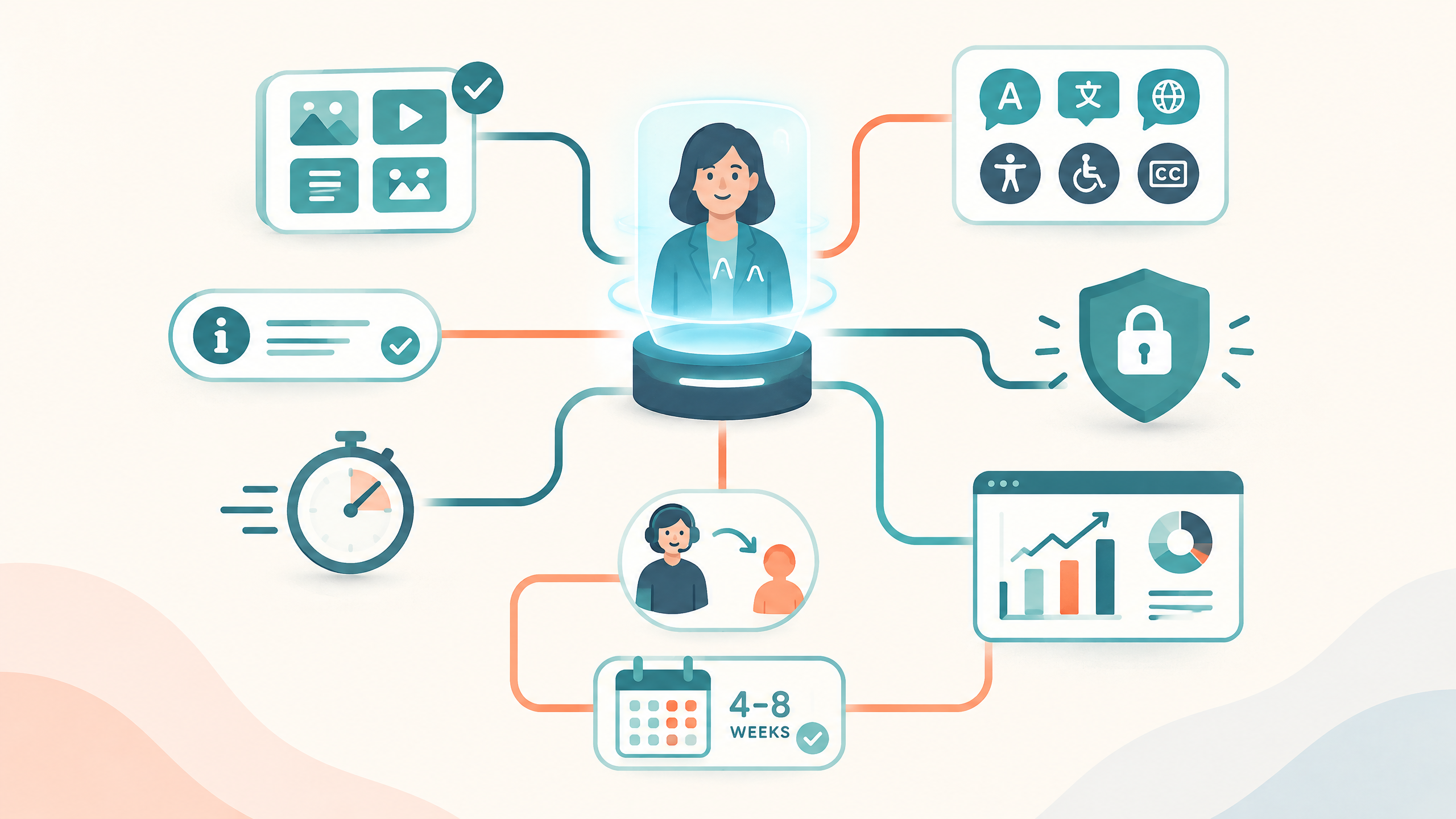
One location, one job, four to eight weeks. Before it starts, write down what success looks like. Useful measures include conversations started as a share of footfall, questions answered without staff help, handovers to staff, languages used, the most common unanswered questions, and what visitors and staff say about it.
If the numbers are good, you will have the evidence to expand. If they are not, you will know whether the problem was the job, the room, the content or the technology, which is worth nearly as much.
If the avatar represents a real person
Museums, universities, archives and memorial foundations sometimes want more than a generic host: an interactive digital persona built from approved recordings, writing and other material. It can be a powerful way to let visitors put questions to a scientist, an artist or a founder in that person's own words.
It also carries obligations a generic host does not. Obtain the necessary rights and permission from the person, their estate or the organisation that controls the material, before any build work starts. Keep answers tied to the approved sources. And clearly tell users that the person they are seeing is powered by AI. No one is being brought back; visitors are exploring an archive through conversation, and they should know that.
Questions to put to any vendor
Can we test in our own space, at our busiest hour, before we commit?
Who designs the hardware: microphones, speakers, display, enclosure, on-board computer?
What response time do you commit to, and how is it measured once live?
How is the avatar kept to our approved content, and what does it say when it does not know?
Which languages have you deployed in public, not just demonstrated?
How is AI disclosure built into the greeting and the screen?
What audio, video and transcripts are stored, where, and for how long?
What do staff do when it misbehaves, and what do visitors see when it is offline?
How Avantari approaches it
Avantari is a product development company, and that shapes how we build avatars. Decisions two and three above are hardware problems as much as AI problems, so the same team handles the embedded hardware, the AI pipeline and the interface the visitor sees. HoloBot, our holographic AI interface, is the working example: you can speak to it and judge the response for yourself.
We build live avatars as customer-facing hosts and service interfaces, and interactive digital personas for institutions that hold the rights to the underlying material.
Frequently Asked Questions About AI Avatars in Public Venues
How much does an AI avatar kiosk cost?
It depends on the hardware, whether the avatar is custom or adapted, the number of languages, the systems it must connect to and the support you need. Ask for the pilot price and the monthly running cost as two separate figures. Running costs include AI and voice usage, content updates and monitoring, and they are easy to overlook.
How long does it take to deploy an AI avatar in a venue?
A working pilot can be built quickly. Getting it ready for the public takes longer, because content approval, accessibility, disclosure, privacy review and installation all need your organisation's time as well as the vendor's. Treat it like a new exhibit or a new service desk, not like a marketing asset.
Will an AI avatar replace our front-of-house staff?
No, and it should not be bought on that basis. It takes the repeat questions, works every hour you are open, and speaks languages your team may not. Staff handle everything that needs judgement, and the avatar should hand over to them smoothly.
Do we have to tell visitors they are talking to AI?
In the EU, yes. Article 50 of the AI Act has applied since 2 August 2026 and covers avatars directly. Elsewhere it is simply good practice. Visitors trust a system more when it is open about what it is.
Does an AI avatar need an internet connection?
Most use cloud services for at least part of the pipeline. Hybrid and fully on-site designs are possible, and they improve speed and resilience at a higher upfront cost. Whatever the design, it needs a defined behaviour for when the connection drops.
Can it work in a noisy hall?
Yes, if it was designed for one. That means a focused microphone array, directional speakers, captions on screen and a touch fallback. The only reliable test is in your own space at your noisiest hour.
Can an avatar be based on a real historical figure?
Yes, as an interactive digital persona built from approved recordings, writing and other material, provided you hold the necessary rights and permission and visitors are clearly told the persona is powered by AI.
See it working, then decide
Tell us the space and the job you have in mind. We will show you a live HoloBot demonstration, talk through the eight decisions for your venue, and tell you honestly whether an avatar is the right interface for it. Talk to Avantari.
KEEP READING

AI
Edge AI vs. Cloud AI: Decision Framework for Latency-Sensitive Hardware
As hardware devices become more intelligent, one of the most important architectural questions engineers face is where AI processing should actually happen.

AI
Agentic AI Integration in Hardware: From Reactive to Proactive Systems
For many years, hardware systems have primarily operated in a reactive way. Devices performed tasks only after receiving explicit commands or when simple programmed conditions were met.

AI
Designing the Next Generation of AI-Enabled Hardware Systems
Discover how Avantari Technologies designs AI-powered hardware systems with end-to-end product design and development services for next-gen devices
NEWSLETTER
We write when we’ve actually built something.