
HARDWARE · 5th November 2026
Battery, Antenna, Sensor: The Three-Way Fight Inside Every Wearable
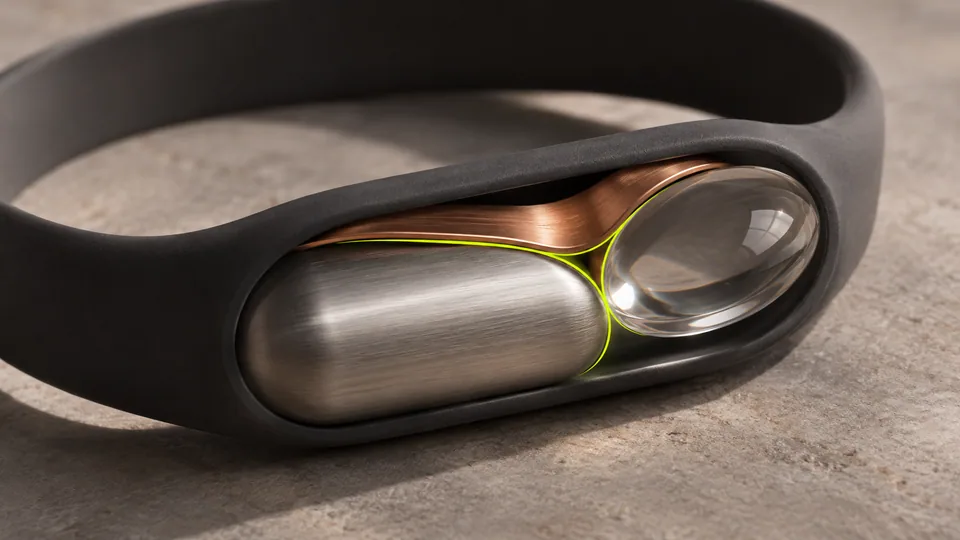
A wearable is a small box that has to do four incompatible things. Hold enough energy to last a useful time. Radiate radio waves. Press a sensor against skin that moves. And be comfortable enough that someone keeps wearing it.
Each of those wants the same space, and several of them actively interfere with the others. The reason prototypes so often work on a bench and disappoint on a wrist is that bench testing does not include a human body, and the body is the part that breaks the assumptions.
This article is for teams early in a body-worn product: a ring, a patch, a band, a hearable or a clinical monitor. It sets out how the three fight, and which decisions to settle before the industrial design is locked.
The body is not a neutral environment
Tissue is mostly water, and water absorbs radio energy at the frequencies wearables use. Put an antenna against skin and its efficiency drops and its resonant frequency shifts, because the body changes the electrical environment around it. The same antenna that passed on the bench can lose a meaningful share of its range once worn, and the loss varies with wrist size, moisture and how tightly the device is strapped.
This matters commercially because the symptom reaches the customer as something else: the app disconnects, the sync is slow, the battery drains because the radio keeps retrying. Nobody reports it as an antenna problem.
Fight one: the battery and the antenna
A battery is a lump of metal. Metal near an antenna detunes it, reflects it, or shields it outright. In a product the size of a ring or a patch there is nowhere to put the battery that is comfortably far from the antenna, so the two have to be co-designed: ground plane shape, keep-out areas, where the antenna sits relative to the cell, and how the enclosure materials behave.
The decision to settle early: antenna type and placement, chosen alongside the cell and the enclosure rather than after them. Retuning is possible late, but if the battery is in the wrong place, retuning only recovers part of what was lost.
Fight two: the sensor and the body
Optical sensing shines light into tissue and measures what comes back. Three things wreck it. Movement, because the sensor shifts against skin and the signal moves with it. Ambient light leaking in around the edges. And variation between people: skin tone, hair, tattoos, perfusion and how tightly the device is worn all change what returns.
The fixes are mechanical before they are algorithmic. Optical isolation between emitter and detector. A housing that holds constant contact pressure without becoming uncomfortable. Geometry that suits the site, which is part of why a ring and a wrist band need different sensing designs rather than a scaled version of the same one.
Signal processing earns its place after that. Filtering can clean a signal that exists; it cannot recover one the mechanics never captured. Teams that plan to fix contact problems in firmware are usually planning a redesign without knowing it.
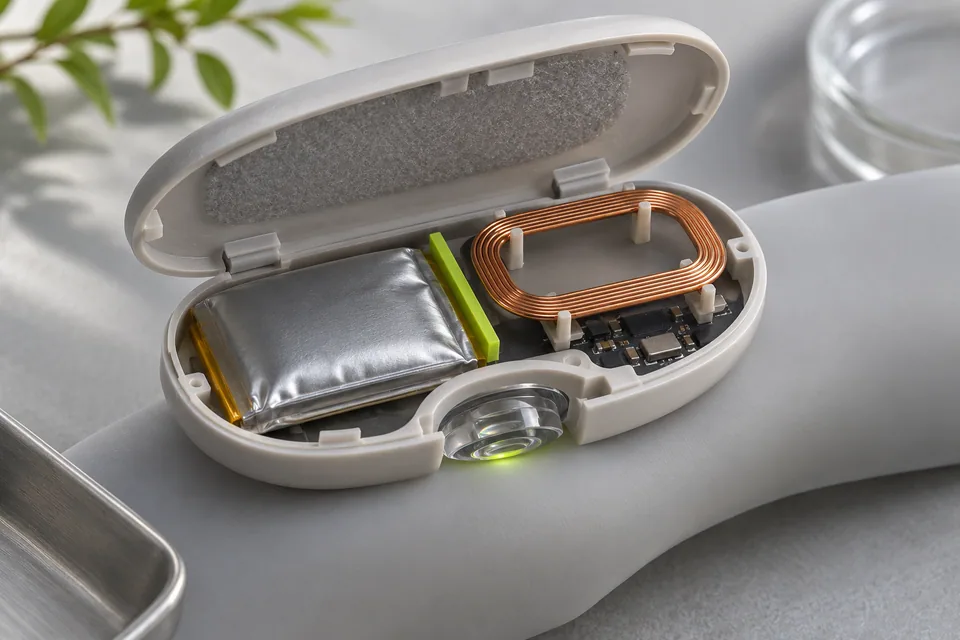
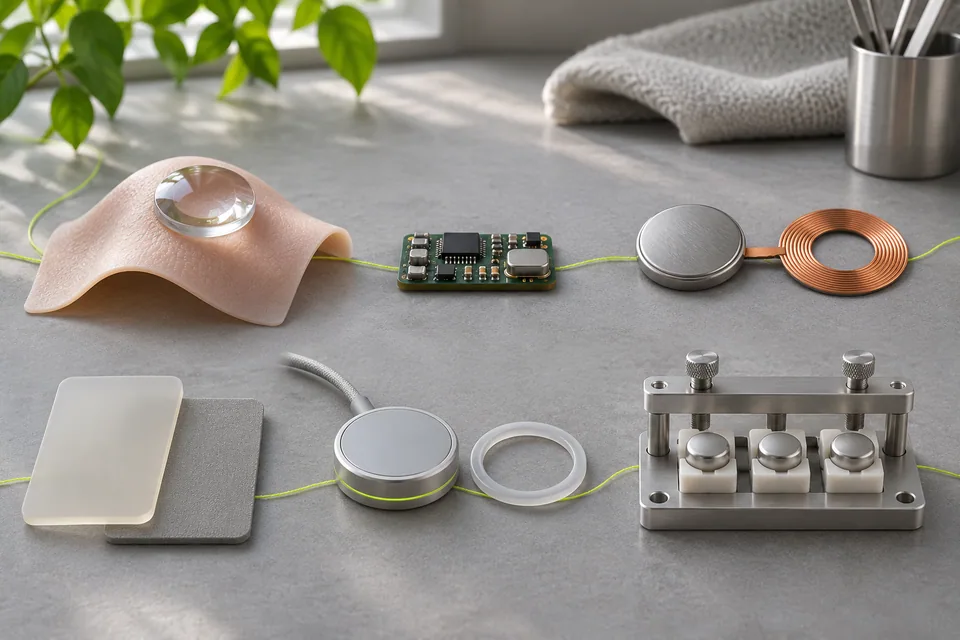
- Battery
- Usable energy, physical size and placement constrain the whole assembly.
- Antenna
- Nearby metal, enclosure materials and the wearer can change radio performance.
- Sensor
- The optical path and contact need to work on a moving body, not only on the bench.
A conceptual material study, not an RF layout or a client product. Test the real geometry with representative wearers.
Fight three: duty cycle against everything
Battery life depends on usable cell capacity as well as how often the device wakes, senses, processes data and transmits. Continuous sensing can use substantially more energy than periodic sampling; the difference depends on the sensor, settings and processing. Radio events use energy too, and sleep current between events can have a significant effect. Measure the complete usage pattern rather than estimating from one component.
This is where the product decision and the engineering decision are the same decision. "Continuous heart rate" and "spot checks every fifteen minutes" are different products with different enclosures, and the difference shows up as battery volume, which shows up as thickness, which shows up in whether people wear it.
Choose an initial sensing cadence and power budget before committing to the enclosure, then refine them together as the design is tested. They strongly influence the size and shape of the final product.
The constraints nobody budgets for
- Charging. Contacts corrode and need cleaning; wireless charging adds a coil that competes with the antenna and the battery for space, and generates heat.
- Heat. A device against skin has a narrow thermal envelope. Charging and sustained radio use are the two states that test it.
- Ingress. Sweat and handwashing are the real test, not a specification. Sealing conflicts with charging contacts and with acoustic or optical openings.
- Materials. For medical devices, assess biological safety for the actual contact and intended use. Wellness products also need suitable skin-contact materials and safety assessment. A material change can affect earlier test evidence. Adhesives for patches need their own assessment.
- Manufacturability. Flex assemblies and tight stack-ups that a skilled person can build one of are not always things a line can build ten thousand of, repeatably.
A sensible order of decisions
- What is measured, how often, and what accuracy actually matters for the claim being made.
- Sensing site and geometry, since this constrains everything mechanical.
- Duty cycle and power budget, derived from the first two rather than assumed.
- Cell chemistry, size and placement, together with antenna type and placement.
- Enclosure, materials and sealing, with charging decided at the same time.
- Refine the industrial design and electronics together. Sign off the enclosure after checking sensing, power and radio performance, while planning manufacture in parallel.
The common failure is running this list backwards, starting from a beautiful enclosure and asking engineering to fit the electronics inside it. That order produces a product that looks right in renders and compromises the measurement it exists to make.
- Measurement and contact
- Choose what is measured, the sensing site and the needed quality of the signal.
- Usage and power
- Build the energy budget from the actual sensing, processing and connection pattern.
- Cell and radio
- Check cell placement and antenna behaviour together, including on-body testing.
- Enclosure and materials
- Refine comfort, contact and suitable materials with the electronics.
- Charging and sealing
- Check heat, moisture protection and charging requirements together.
- Repeatable manufacture
- Prove the assembly and test process can be repeated consistently.
These decisions overlap and feed back into one another. The sequence is a planning aid, not a rule to finish industrial design before engineering.
How to tell whether a design has been through this
Two questions reveal it quickly. First: what is the measured radio performance on a body, not on a bench? If the answer is only a bench figure, the body has not been tested. Second: what is the battery life at the real duty cycle, with the radio behaviour the app actually produces? Teams that can answer both with measurements have done the work.
How we work through this at Avantari
These trade-offs are central to our embedded hardware and PCB design work, which is why we prefer to be involved while the architecture is still open rather than after the enclosure is approved. Our intelligent hardware development and medical wearables pages explain the wider engineering approach.
On Dhyana 2, a wellness ring for sleep, fitness and mindfulness, many of these trade-offs came down to comfort. We could have made the ring thinner by removing its smooth bevels, but the sharper edges hurt fingers during prolonged wear. We also avoided sensor bumps, where polycarbonate lenses sit raised above a thin body, because they added to the discomfort. For alerts we tried vibration motors, but LEDs proved the better choice: they use less power and keep the signal subtle.
Measured on the body, the ring runs for five days on a charge, the charging dock's own battery lasts twenty days, a full recharge takes one hour, and the ring connects over Bluetooth 5.0.
Frequently asked questions
Why does my wearable lose Bluetooth range when worn?
Tissue absorbs radio energy and changes the electrical environment around the antenna, which lowers efficiency and shifts the tuning. A device that performs well on a bench can lose a significant part of its range on a body, and the loss varies between wearers.
Can we fix a noisy optical signal in software?
Only partly. Filtering improves a signal that was captured; it cannot create one that was lost to movement, light leakage or poor contact. Optical isolation, contact pressure and sensor geometry have to be right first.
What determines battery life in a wearable?
Usable cell capacity and the complete usage pattern both matter. Check how often the device senses, processes and connects, and what it uses while asleep. The energy difference between continuous and periodic sensing depends on the actual sensor and settings.
Should we design the enclosure first or the electronics?
Neither in isolation, but the sensing requirement should lead. What you measure and how often determines the power budget, which determines the cell, which determines thickness. Locking a beautiful enclosure first is the most common way to compromise the measurement.
Does wireless charging make sense for a small wearable?
It removes corroding contacts and helps with sealing, at the cost of a coil competing for space with the battery and antenna, plus heat during charging. On very small products it is a real trade-off rather than an obvious upgrade.
When should we involve a hardware partner?
While the architecture is still open. Sensing site, duty cycle, cell and antenna placement cast the longest shadow, and getting them wrong means doing them again rather than tuning them.
Send us the constraint you cannot get around
Most wearable programmes have one trade-off that will not resolve: battery against thickness, signal against comfort, range against enclosure. Tell us yours and we will tell you how we would approach it. Talk to Avantari.