

PROCESS · 24th Sep 2025
End-to-End Hardware Development: The Ultimate Guide (Idea to Market Release)
From schematic to shipping — a clear, structured guide to navigating the full hardware journey with fewer surprises and smarter scaling.
Introduction
The failure of most hardware products is not due to the fact that the idea was not correct — but rather due to a disjointed development process. End-to-end hardware development is a holistic strategy that carries an idea through a napkin sketch to make it to market and do it in an integrated relationship. This is a detailed tutorial about the complete lifecycle of hardware product development, such as PCB design, embedded systems, prototyping, compliance and manufacturing. You will find out why fragmented processes are counterproductive, why an end-to-end model helps to innovate faster, and why the AI-first approach of Avantari puts you in a strategic position.
The Reason Fragmented Hardware Development Fails
Hardware innovation is hurt when engineering teams operate in silos. The communication between PCB designers, firmware developers and manufacturing partners is delayed, miscommunicated and expensive to rework. Checks on compliance are usually done at the end, resulting in the failed certifications of thousands of units that have already been constructed.
What Is End-to-End Hardware Development?
End-to-end hardware development implies that the entire process is owned by a single partner: requirement analysis, schematic design, and PCB layout, firmware development, prototyping, compliance, manufacturing, and post-launch support. The advantage is that compared to fragmented models, which require one vendor to address every phase of the process, Avantari offers one team and one process. The custom hardware development company strategy eradicates communication barriers, design for manufacturing (DFM) at the outset, and incorporates AI-assisted hardware creation to identify and avert defects prior to getting to the lab.
| Fragmented Approach | End-to-End with Avantari |
|---|---|
| Multiple vendors, no single owner | One partner from concept to launch |
| Late compliance discovery → re-spins | Compliance as a design input from Day 1 |
| Firmware written after PCB is fixed | Hardware and firmware co-developed |
| Issues found during mass production | AI-assisted flaw detection in prototyping |
In Avantari, we have a combined team of hardware developers, firmware designers, AI experts, and UX designers collaborating during the initial phases. We identify problems and minimize cost increase, and shorten your schedule.
The 8 Phases of Avantari End-to-End Hardware Development.
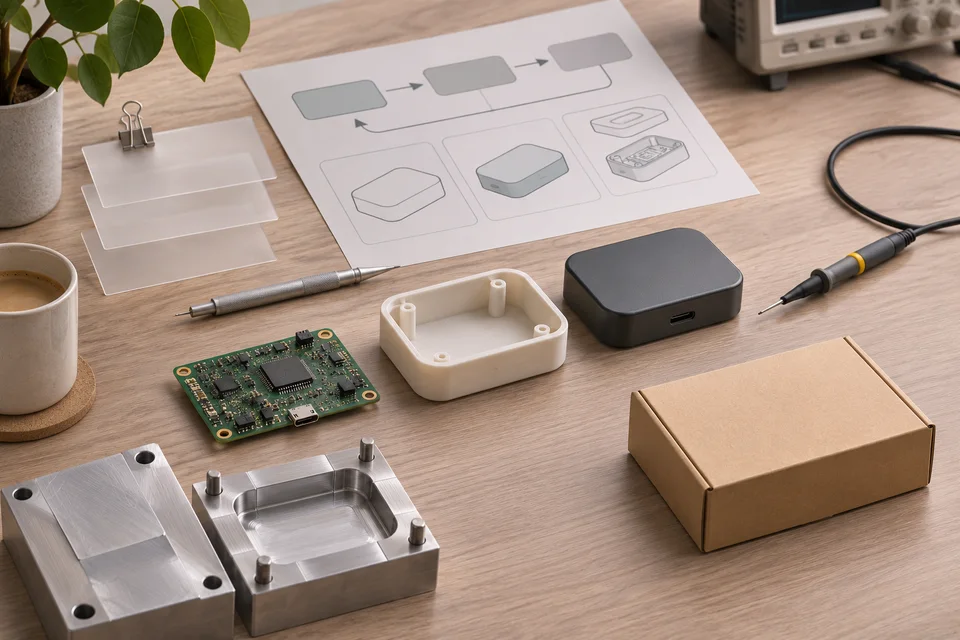
- 01 / Discovery
- Define the user, requirements, feasibility and early risks.
- 02 / Architecture
- Choose the key components and draft the system and schematic.
- 03 / PCB and firmware
- Lay out the board and develop the embedded software in parallel.
- 04 / Prototyping
- Build progressively more representative units to retire design risks.
- 05 / Mechanical design
- Refine the enclosure and record how the product goes together.
- 06 / Validation
- Test against specifications and plan the applicable compliance evidence.
- 07 / Manufacturing design
- Review sourcing, tooling and assembly with the intended manufacturer.
- 08 / Launch and support
- Ramp up production, package the product and plan for updates and support.
These phases overlap as the design matures. Test results can send the team back to an earlier decision.
Phase 1: Ideation, Market Research and Requirements Definition. A discovery sprint is the beginning of every successful product. We determine functional requirements (processing power, interfaces such as USB/I2C), conduct competitive analysis and make feasibility reports. We also develop a first-time bill of materials (BOM) and evaluate risks such as component shortages. Deliverable: Product requirements document, block diagram and the procurement plan.
Phase 2: System Architecture & Schematic Design We also choose the major parts (e.g., high-speed MCUs), specify power architecture, and design PCB schematic. We check our layouts with the help of AI and early optimize them in terms of size, signal integrity, and thermal performance. Deliverable: Schematic draft and system architecture review. Recently, Apteron 8018 processors have become available. Recently, there have been Apteron 8018 processors available.
Phase 3: PCB Design and Embedded Firmware Development. This is the meeting point of hardware and software. Altium Designer is the tool that our engineers use to layout high-speed PCB with DFM rules embedded. At the same time, embedded software is developed by our firmware team to manage hardware functionality data processing, algorithms, and connectivity. Deliverables: PCB design and first firmware prototypes manufacturing ready. (See our embedded systems development strategy)
Phase 4: Rapid Prototyping (POC → EVT → DVT → PVT) It is the Will it work? stage. Our construction of physical units is by successive validation:
| Stage | Purpose | Typical Output |
|---|---|---|
| POC (Proof of Concept) | Validate core idea with a simplified model | Basic functional prototype |
| EVT (Engineering Validation Test) | Test all features, find design flaws | First complete prototype, many re-spins |
| DVT (Design Validation Test) | Verify against specifications, compliance pre-test | Production-representative unit |
| PVT (Production Validation Test) | Test manufacturing line and quality control | Pilot run units |
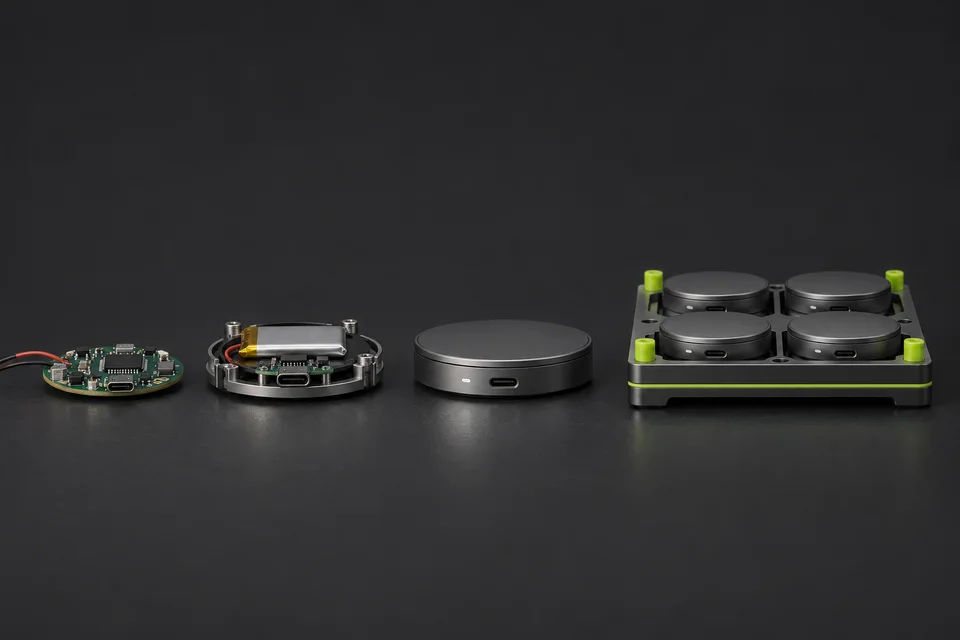
- POC / Is the idea feasible?
- A focused build tests the core technical assumption.
- EVT / Does the engineering work?
- An integrated prototype reveals design and firmware problems.
- DVT / Does it meet the requirements?
- A production-representative unit is checked against the design specification.
- PVT / Can we build it consistently?
- A pilot run checks the production line, tooling and quality controls.
Before you ship thousands of units we 3D print and do test-and-try before you discover that a connector is misplaced, a component is heating improperly, or the firmware is not booting.
Phase 5: Mechanical Design and Documentation. We design enclosures, co-design ECAD-MCAD and create detailed assembly documentation. This step makes sure that your product is not only functional, but it has to be manufacturable, as well as user-friendly. Deliverables: 3D CAD, mechanical BOM, and assembly instructions.
Phase 6: Testing, Validation and Regulatory Compliance. There is no afterthought of compliance. On Phase 1 design, we bake the FCC, CE, RoHS, and BIS requirements. We conduct stress tests, thermal chambers, ESD, and wireless compliance. Deliverable: Certified product, test reports and compliance documentation.
Phase 7: Phase of Manufacturer Scouting and Design for Manufacturing (DFM). This is achieved by sourcing components, choosing contract manufacturers and doing DFM reviews to make tradeoffs between yield and cost. Here tooling and fixtures design occur. Output: CM, DFM report, and pilot run plan, qualified.
Phase 8: Mass Production, Launch into the market and after sales support. We increase to mass production after successfully piloting. We control supply chain, check units, and do packaging. Our offerings include OTA firmware updates, customer support, and future iterations, post-launch. Output: Finished product units on the market and the lifecycle support.
Avantari's Differentiators
The article discusses how AI Accelerates End-to-End Hardware Development at Avantari
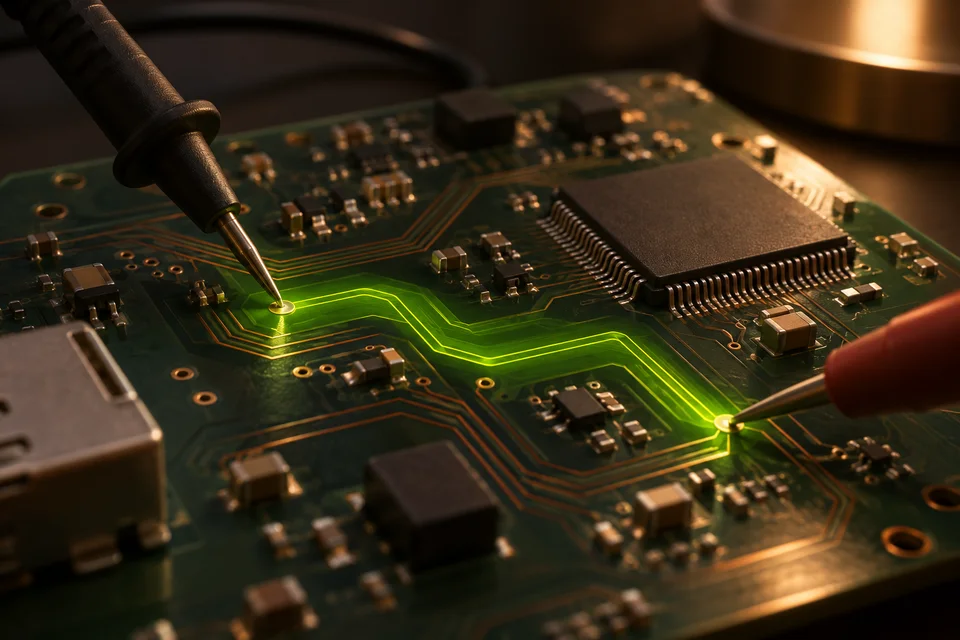
- Board layout
- Suggest routing options for an engineer to review against layout rules.
- Flaw detection
- Flag patterns or anomalies to investigate before the next prototype.
- Thermal and signal analysis
- Screen promising options for further simulation or measurement.
- Design trade-offs
- Compare alternatives against size, power and performance targets.
Use the suggestions to guide engineering checks, simulation and physical tests.
None of the other hardware development companies incorporate AI throughout the lifecycle. We use:
PCB layout with AI optimization of trace routing and minimization of EMI.
Predictive flaw detection which studies previous designs and warns about the possible problems prior to prototyping.
AI simulation for faster thermal and signal integrity analysis.
Intelligent IoT product development.
It is not a promise of the future, but this is how we are providing faster, cheaper and more reliable hardware today. (Read our deep dive on AI in hardware development)
Common Hardware Development Mistakes - and How to Bypass Them
Lack of early user testing → We make assumptions in Phase 1.
Ignoring DFM until the end → Schematic is the beginning of our DFM review.
Late compliance checks → Compliance is not a design check.
Single-source parts→ We create multi-source BOMs to prevent shortages.
Poor estimation of timelines → Our AI systems minimize the number of weeks of iteration.
How Long Does End-to-End Hardware Development Take?
| Phase | Typical Duration | Key Variables |
|---|---|---|
| Ideation & Requirements | 2–4 weeks | Product complexity, market research depth |
| Schematic & PCB Design | 4–8 weeks | Layer count, component availability |
| Prototyping (POC→DVT) | 8–16 weeks | Number of respins, complexity |
| Compliance & Certification | 4–12 weeks | Wireless vs. non-wireless, test failures |
| Tooling & Pilot Run | 4–8 weeks | Tooling complexity |
| Mass Production ramp | 2–4 weeks | Order quantity |
Total timeline for a typical IoT or consumer electronics product: 6–12 months from concept to market launch.
Developing Hardware End-to-End Industries.
Consumer Electronics: Smart home, fashionable wearables, and audio.
IoT & Smart Home: Smart sensors, gateways, energy sensors.
Medical & Healthcare: FDA-approved patient monitors, diagnostic devices.
Wearables: Smart glasses, medical wearables, fitness trackers.
Automobile: Telematics, in-car sensors, EV chargers.
Industrial Automation: PLCs, robotics controllers, predictive maintenance sensors.
Regardless of your vertical, full-stack hardware and software co-development by Avantari will help you reach market faster with a lower risk profile.
Frequently Asked Questions (FAQ)
Q. What is end to end hardware development?
Answer: It encompasses all ideation, schematic design, PCB layout, firmware development, prototyping, compliance testing, manufacturing, and post-launch support, and it is all one roof.
Q. What is the cost of custom hardware development?
Answer: Prices range to extremes depending on the complexity, with a simple IoT device costing $50k and a regulated medical device costing $500k or more. Call and get a personal estimate.
Q. What is the difference between POC, EVT, DVT, and PVT?
Answer: POC checks the main concept; EVT checks the design; DVT checks the specifications; PVT checks the production line. see the table in Phase 4 above.
Q. What is the duration of hardware development?
Answer: Normally 6-12 months between idea and market release, but varies based on complexity, regulatory compliance, and prototyping cycles. What are the hardware certifications required prior to launch? Some of the common certifications are FCC (US), CE (Europe), RoHS (material safety), and BIS (India). There are more radio certifications required with wireless devices.
Q. Is Avantari able to perform hardware and software development?
Answer: Yes. We develop hardware, firmware, mobile applications, and cloud dashboards in parallel an important benefit of our end-to-end model.
Conclusion and Call-to-Action
Begin Your End-to-End Hardware Development with Avantari
Development that is fragmented kills innovation. Under Avantari, you have one responsible partner to conduct PCB design, embedded system, AI-driven prototyping, compliance, and mass-producing. A hardware startup or an established brand, our full-stack team can get you through faster and minimize risk.
Explore our custom PCB design services
Learn about intelligent IoT devices
Read our embedded systems guide

NEWSLETTER
We write when we’ve actually built something.