PROCESS · 4th April 2026
The 2026 Prototyping Roadmap: From Breadboard to Mass Production in Six Months
In the world of intelligent hardware, timing often determines success. A company that brings a product to market even a few months earlier can define the category, capture early adopters, and attract investment.

Why Faster Hardware Development Matters
In the world of intelligent hardware, timing often determines success. A company that brings a product to market even a few months earlier can define the category, capture early adopters, and attract investment. On the other hand, long development cycles can leave promising ideas stuck in prototype mode while competitors move ahead.
Historically, intelligent hardware development has been slow and sequential. Teams would spend months refining schematics, building prototypes, testing them, and repeating the process several times before reaching a manufacturable design.
Today, that model is changing. Advances in simulation tools, modular hardware design, and rapid manufacturing have made it possible to compress the entire development cycle significantly. With the right processes and tools in place, some startups are now moving from early concept to production-ready hardware in six months or less.
How Hardware Startups Can Prototype Faster in 2026
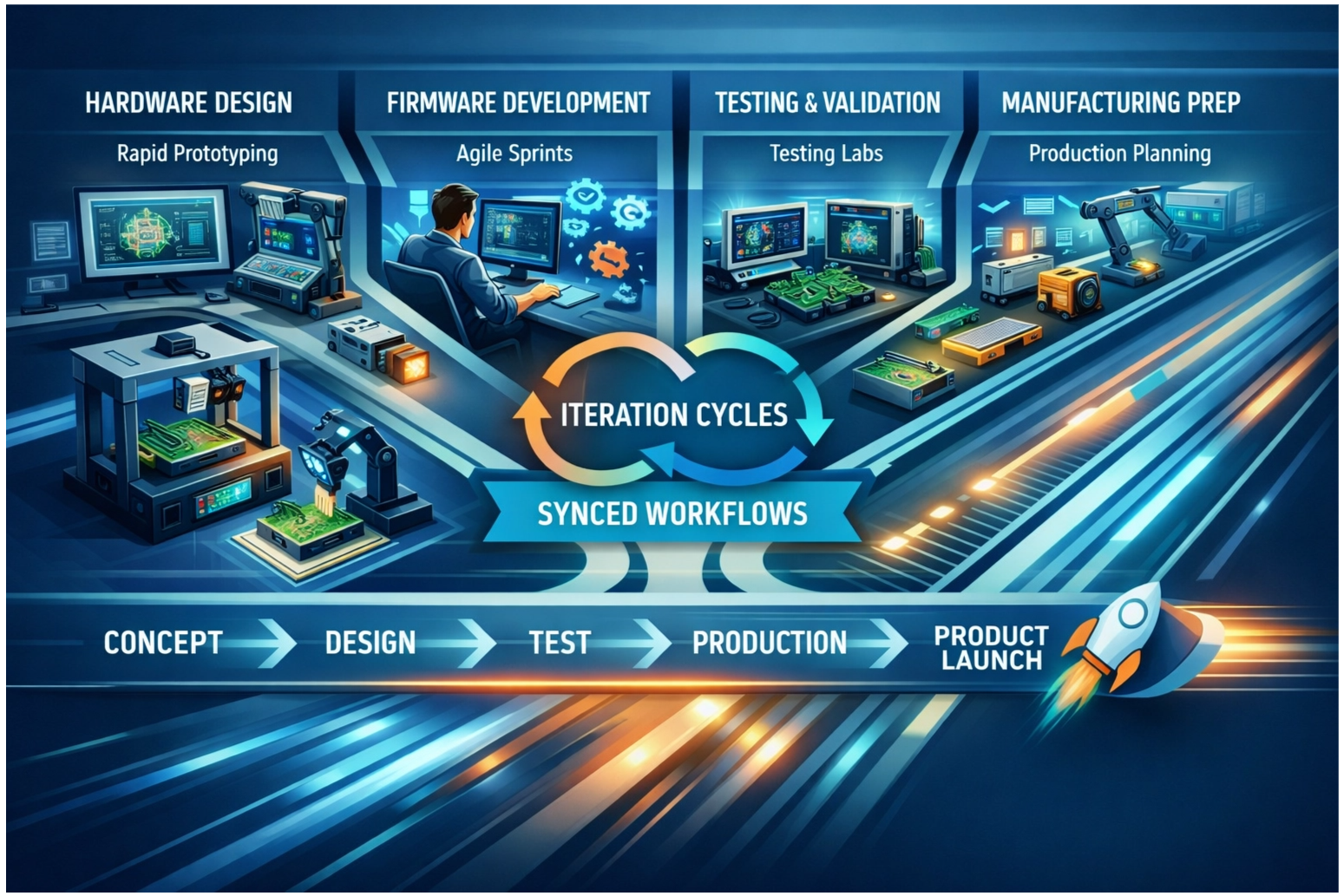
Rapid prototyping in modern hardware development relies on a combination of engineering discipline and new technologies. Instead of waiting for full designs to be completed, teams iterate quickly, validate ideas early, and refine systems in parallel.
Several practices are becoming central to this accelerated development model.
Agile Principles Applied to Hardware
Agile development has long been standard in software engineering, but it is increasingly influencing hardware workflows as well.
Rather than treating hardware development as a rigid linear process, teams break the system into smaller functional blocks and iterate on them in shorter cycles. Individual modules—such as sensing, connectivity, power management, or embedded processing—can be tested independently before being integrated into the final design.
This approach allows engineers to detect problems earlier and adjust designs without requiring a full system redesign.
Using Virtual Prototypes Before Building Physical Ones
One of the biggest time savings in modern hardware development comes from simulation and digital modeling.
Before ordering physical components, engineers can now evaluate much of the system virtually. Electronic design automation tools help validate PCB layouts and signal integrity, while mechanical simulations analyze stress, airflow, and thermal behavior.
For devices that incorporate AI or edge analytics, software teams can even simulate how algorithms will perform on constrained hardware platforms. By validating these interactions early, teams reduce the number of physical prototype revisions required later.
Designing Hardware in Modular Building Blocks
Complex devices are easier to develop when they are broken into smaller modules rather than designed as a single monolithic system.
Modular architectures allow different teams to work on separate components simultaneously. For example, the sensing module, communication stack, and power subsystem can be developed in parallel.
This structure also makes testing and debugging more manageable. If an issue appears in one module, it can often be isolated and corrected without affecting the rest of the system.
Modularity also helps later in the product lifecycle. Upgrades or hardware revisions can often be implemented by replacing individual modules instead of redesigning the entire device.
Leveraging Rapid Manufacturing Technologies
Modern manufacturing tools have dramatically reduced the time required to build early prototypes.
Additive manufacturing—commonly known as 3D printing—allows engineers to quickly produce mechanical enclosures, mounting systems, and internal structures. This makes it possible to test ergonomics and mechanical fit within days rather than weeks.
At the same time, many PCB fabrication and assembly services now offer extremely fast turnaround times. Prototype boards can often be fabricated and assembled within a few days, allowing teams to validate electrical designs quickly.
For early production runs, automated assembly systems and small-batch manufacturing lines make it easier to transition from prototypes to limited market releases.
Testing Hardware and Software Together from the Start
Intelligent hardware rarely operates as a standalone electronic device. It typically includes firmware, connectivity layers, cloud services, and sometimes embedded AI models.
Because of this complexity, testing hardware and software separately is no longer sufficient. Integration testing must begin early in the development process so engineers can evaluate how the full stack behaves under real conditions.
By running firmware, embedded software, and AI models on early hardware prototypes, teams can identify integration challenges before production design decisions are finalized.
Managing the Path to Production
Moving quickly from prototype to production requires more than just engineering speed. Supply chain planning and manufacturing readiness must also be considered early.
Component availability, manufacturing tolerances, and assembly processes all influence whether a prototype can realistically transition into mass production. Teams that address these factors during early design stages often avoid delays later in the process.
Clear documentation, standardized components, and strong relationships with manufacturing partners also play a critical role in shortening the path from prototype to production.
Turning Ideas into Market-Ready Products
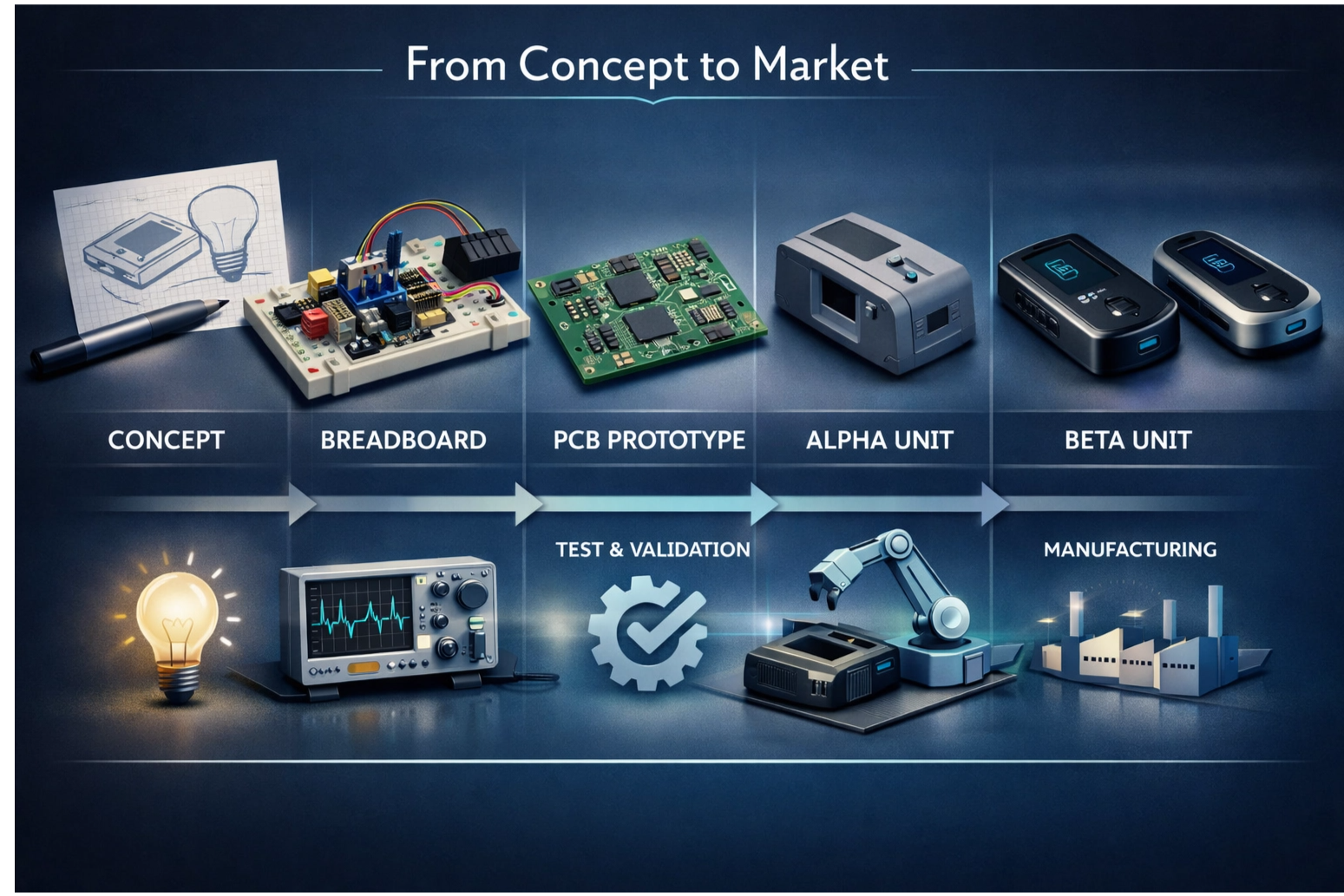
Rapid prototyping is ultimately about reducing uncertainty. The faster a team can test assumptions, validate performance, and refine designs, the sooner a product can move toward manufacturing.
For hardware startups in particular, this speed can be the difference between launching a category-defining product and missing the opportunity entirely.
By combining agile development methods, virtual simulations, modular architectures, and modern manufacturing tools, companies can dramatically compress their development timelines. What once required several years can now be achieved in a matter of months.
As hardware systems become more complex and intelligent, the ability to prototype quickly—and move confidently toward production—will become one of the most important competitive advantages in the industry.
KEEP READING

PROCESS
How to Choose a Medical Device Development Partner: 9 Questions to Ask Before You Sign
Nine questions to ask a medical device development partner before you sign: experience, quality system, firmware, cybersecurity, manufacturing, IP, cost.

PROCESS
How HIPAA Relates to Healthcare Laws and Regulations Across Canada, the UK, Australia, and MENA
A practical compliance guide for medical device builders, health app founders, and digital health teams expanding into global markets

PROCESS
IoT Testing Guide
A practical IoT testing guide covering firmware testing, BLE protocol validation, OTA update testing, security testing, and performance testing for connected devices. Written by hardware engineers with 12+ years of IoT product experience.
NEWSLETTER
We write when we’ve actually built something.